Book Review: “Ravenous: A Life of Barbara Villiers, Charles II’s Most Infamous Mistress” by Andrea Zuvich

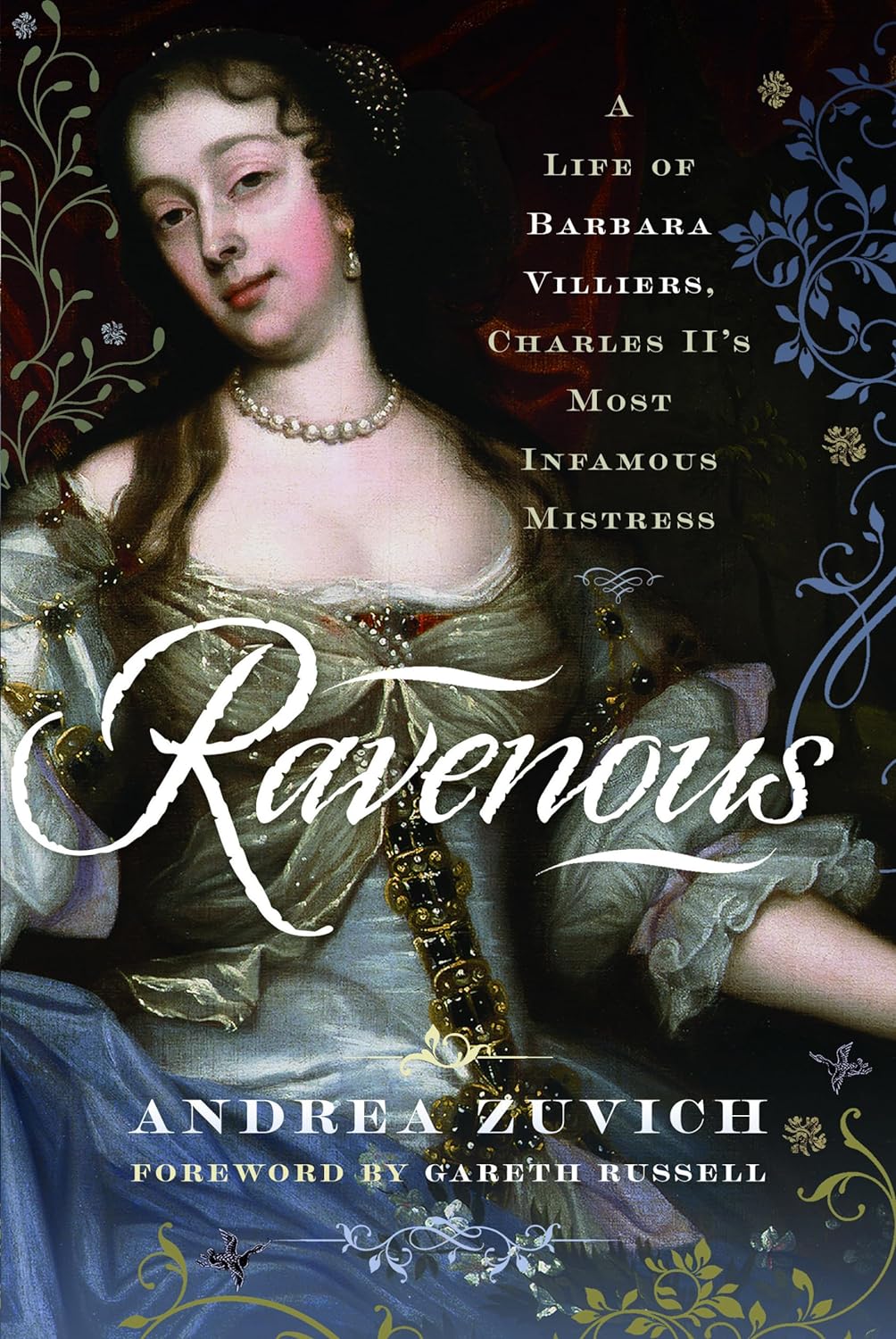
My good friend and historian Andrea Zuvich kindly provided me with a copy of her latest book “Ravenous” which I was happy to read and review. As the title infers, Villers is not a very sympathetic or even likable character. Zuvich’s treatment of Barbara is very even handed, neither extolling her character nor denigrating her in the process. By providing the complex details of Barbara’s life, we get a complete view of her.

Barbara’s family, the Villiers, were integral operators in the Stuart monarchy beginning with the reign of James I. Zuvich gives us some background into the family, and Barbara was related to one of the more minor family members. From the time she was a teenager, she engaged in carnal relations with an aristocratic member of the court. Although this relationship did not result in a marriage, Barbara had a connection with the man throughout her whole life. Early on, Barbara managed to gain access to King Charles II, even while he was in exile and before his restoration to the English throne. By the time this happened, she was Charles’ maîtresse en titre, in the tradition of his grandfather, King Henri IV of France.

This would be Charles II’s longest lasting relationship, especially due to the birth of several children with Barbara, in effect creating a family unit which he supported until his death. Initially, Barbara engaged in political and diplomatic matters at court and as Zuvich explains, played a role in the disgrace of Henry Hyde, Charles’ chancellor, among others. Charles endowed Barbara with various sizable sources of income, something people grumbled about. He also elevated her, first to the title of Countess of Castlemaine and later to the title of Duchess of Cleveland. All of their male children together were given aristocratic titles and the female children made good marriages.

Later in her life, Barbara engaged in behavior, such as taking lovers and gambling large amounts of money which caused embarrassment for Charles, and she slowly disappeared from any meaningful influence and authority at court. Zuvich has found numerous references to debts and lawsuits for collection in Barbara’s name that make for interesting reading. I especially liked Andrea’s take on the relationship between King Charles and his wife, Queen Catherine of Braganza. She is very fair in her treatment of the queen.

Andrea’s research is meticulous, and she obviously went to great lengths to explore the archives to find intriguing nuggets about Barbara’s life. She also investigates and reports on all the many interrelationships between Barbara Villiers and numerous members of the Restoration Court. There is an extensive collection of illustrations in the book, documenting Barbara’s beauty throughout her life. The book is well written and well-researched. For anyone interested in the Barbara and various intrigues and dealings and interactions between courtiers of the Stuart Restoration court, I can highly recommend “Ravenous”.

For US buyers: Ravenous: A Life of Barbara Villers, Charles II’s Most Infamous Mistress

For UK buyers: Ravenous: A Life of Barbara Villiers, Charles II’s Most Infamous Mistress

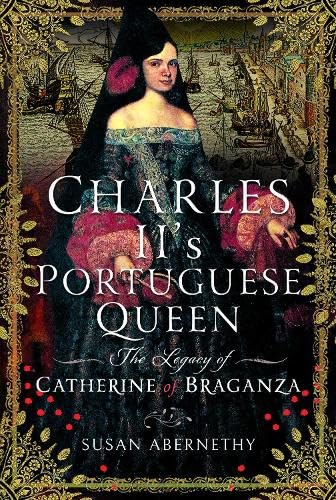
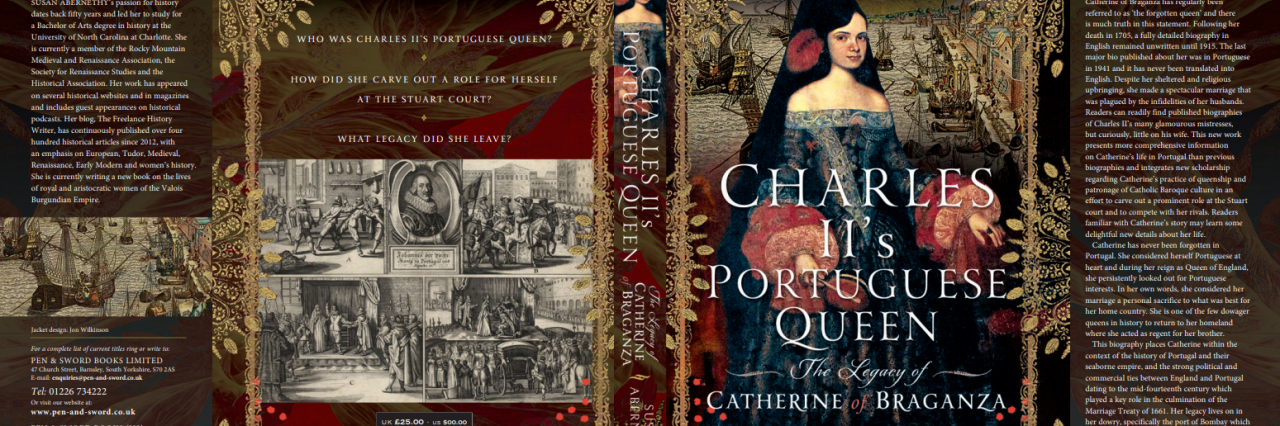
Book Deal: 25% off Charles II’s Portuguese Queen: The Legacy of Catherine of Braganza

Barnes and Noble US is offering members 25% of pre-orders until April 25, 2025. Order your copy of Charles II’s Portuguese Queen: The Legacy of Catherine of Braganza today for delivery on June 30th.

https://www.barnesandnoble.com/w/charles-iis-portuguese-queen-susan-abernethy/1147058576?ean=9781036121648

Charles II’s Portuguese Queen: The Legacy of Catherine of Braganza is now available for pre-order

Exciting News! The Freelance History Writer’s debut book Charles II’s Portuguese Queen: The Legacy of Catherine of Braganza is now available for pre-order. Click on the links below and order your copy today.

To order for shipping to the United States:

From Blackwell’s Booksellers

To order for shipping to the UK and elsewhere in the world:

From Amazon.co.uk

From Pen and Sword publishers

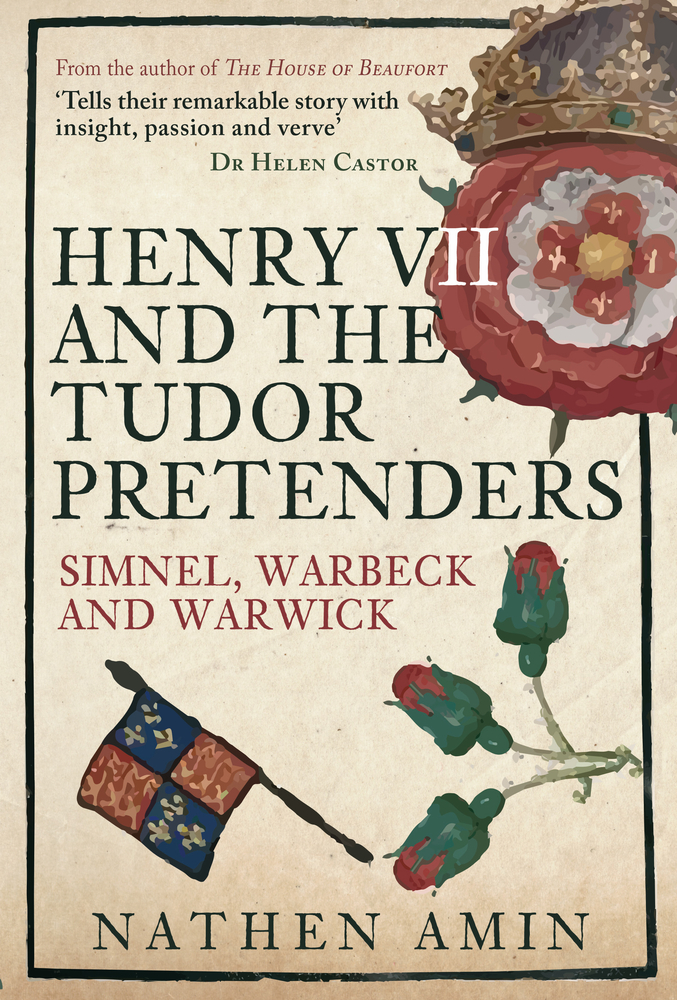
Book Review: “Henry VII and the Tudor Pretenders: Simnel, Warbeck and Warwick” by Nathen Amin

My initial reaction of disbelief to the new ‘revelations’ regarding the Princes in the Tower has not changed, even after viewing the Channel 4 program on US Public TV. In fact, that program was just embarrassing. There is no doubt the documents discovered and viewed are authentic and from the time period in question. Of course, Maximilian provided troops and supplies. Yes, Perkin Warbeck promised the ruler of Saxony he would repay his loan of three hundred thousand florins (worth about $3.4 million dollars in today’s money). Yes, Warbeck signed documents “Richard of England”. These are indisputable facts.

However, these documents are not proof the princes lived. Can anyone explain to me how the actual Richard, Duke of York, assuming he escaped from the Tower of London, was in possession of a royal seal at the age of nine years old?  And, after traveling all over Europe as a young child, how did he still have that seal to sign and authenticate a document in his later years? They never raised this question in the program. And Margaret of York, Duchess of Burgundy naming a room in her palace ‘Richard’s room’ is not proof the actual prince lived.

The dialogue in the scene at the site of the Battle of Stoke Field was a bewildering muddle. Was it a ten-year-old boy at the battle? Or was it the sixteen-year-old King Edward V? The chronicles are also confused as Lambert Simnel claimed at first to be the second son of King Edward IV, Richard, Duke of York. When there were rumors that Edward, Earl of Warwick, (someone who actually did have a claim to the throne), had died, Simnel (or those who promoted him) proclaimed him to be Warwick. At no time did the boy profess to be King Edward V. This is really an unbelievable stretch by the presenters.

The scene with the biographer of Perkin Warbeck was particularly surreal. Reciting a story straight out of historical fiction, she made the events seem totally unbelievable. The look on the lawyer’s face was priceless. What I found most egregious is how the entire program was presented without any historical context whatsoever.

The life and times of these pretenders and the noblemen and rulers who promoted him must be taken in context. In order to spook King Henry VII, the ruler of a new dynasty, they all had their own personal agendas. If Perkin Warbeck really was the true king, why did nobody rise up in support of him in his three attempts to invade England? The story of Warbeck in particular had an element of implausibility.  But it really did happen and it’s one of the reasons history is so intriguing and fun.

I would urge everyone to read Nathen Amin’s latest book, “Henry VII and the Tudor Pretenders: Simnel, Warbeck and Warwick”.  This is a measured, even handed account of what really happened regarding the men who feigned being the missing Princes in the Tower, putting them in their proper context in history.

Book Review: “Burghley: William Cecil at the Court of Elizabeth I” by Stephen Alford

This book has been on my shelf for some time and I’ve finally had a chance to read it. My knowledge of William Cecil and his role in Queen Elizabeth I’s reign was moderate but I wanted to know more. He certainly loomed large as private secretary and as Lord Treasurer and it is clear his influence was paramount.

Alford had access to all of Burghley’s papers and this book is not really a standard biography. He concentrates on Cecil as a man with glimpses into Burghley’s personal life. There’s a good deal of information on Burghley’s homes of Cecil House on the Strand, Theobalds and Burghley house. Alford stresses how Burghley was a dynast and had a keen interest in genealogy and family trees. He kept meticulous records on every aspect of his life, personal and work related, leaving a large archive for his son Robert to utilize as a minister in Elizabeth’s government, as well as James I’s.

Alford gives lots of interesting details about what Cecil and his family ate, how he entertained the Queen when she visited, his interest in gardening, his illnesses and the hiring of doctors to treat him and the taking of the waters as a cure. The section of Cecil’s early life and his career in university is fascinating. Cecil’s family worked for the earlier Tudor monarchs and introduced William to his career in the government. Cecil worked for Henry VIII, Edward VI, Mary I as well as Elizabeth. Contacts made when Cecil was in school served him throughout his life.

Perhaps the most compelling thing about this book is the intricate particulars of how Cecil strove to bring down Mary Queen of Scots. Alford tells us Cecil operated mostly with words and printed material. He had his own propaganda machine and intelligence network. Using these, collaborating with his protégé, Sir Francis Walsingham, they concocted a plot to implicate Mary Queen of Scots to kill Elizabeth and place herself on the English throne. This is really great stuff and worth the price of the book. For anyone with an interest in the life of William Cecil and intrigue at the Tudor court, I can highly recommend this book. A very enjoyable read.

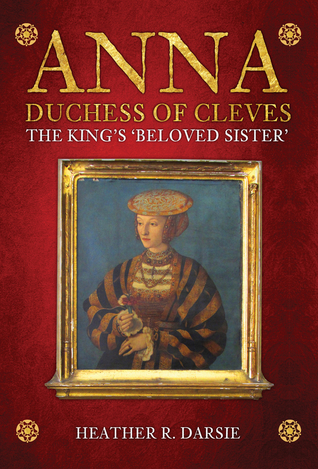
Book Review: “Anna, Duchess of Cleves: The King’s Beloved Sister” by Heather R. Darsie

Anna of Cleves book cover

Everything you know about Anna, Duchess of Cleves, fourth wife of King Henry VIII, is incorrect. Even her name. She was called Anna, not Anne and was a Duchess in her own right. The author has found definitive, primary source, historical evidence that Anna’s birthday is June 28 (or no later than July 1), not September 22, 1515 as previously believed. Even the eventful first meeting between Anna and Henry didn’t go as previously advertised, according to the primary sources.

Darsie places Anna in the context of the Holy Roman Empire, German, and Low Countries history which explains why her marriage came about. She gives the background for the Von der Mark family and the various duchies that made up the patrimony of Cleves and tells how her brother Wilhelm inherited the Duchy of Guelders, thereby angering HRE Charles V and starting a series of wars. Thomas Cromwell’s fall from favor wasn’t based upon the failed marriage but had everything to do with his brokered alliance with the Low Countries and German princes and his failed foreign policy. He didn’t have the skill of his mentor Cardinal Wolsey, to his own detriment.

Darsie uses her training as a lawyer to make convincing and cogent arguments that Anna’s reputation was besmirched, all in the name of obtaining an annulment of her marriage. Once it was determined the alliance with Cleves was no longer necessary, a secret commission was constituted to dissolve the union. Anna had no formal representation on this commission and it was in this covert context that Anna was declared ugly and sexually unattractive, all without her knowing.

Anna was fortunate in that Henry and his advisors wanted to keep the anger and tension with Anna’s brother Wilhelm to a minimum. Consequently, they made a generous offer to Anna of an ample income and the possession of several properties in England. She had no intention of going back to Cleves and enjoyed her life as a free woman, even if she was a little lonely. I can highly recommend this book. It should be the new definitive biography of Anna, Duchess of Cleves and required reading for lovers of Tudor history.

This is where Henry VIII may have found his arguments for annulling his marriage to Anna.

Book Review: “The Brothers York: An English Tragedy” by Thomas Penn

Penns brothers york book cover


Thomas Penn’s “The Brothers York:  An English Tragedy” is chock full of revelations.  His book on King Henry VII “The Winter King”details Henry’s creative accounting and this book does the same with King Edward IV.  Penn breaks down the inventive financing Edward IV engaged in to raise funds for the government and for himself.  Much of the money garnered by these methods went straight to the king’s chamber rather than the Exchequer.  The raising of bonds from nobles in exchange for good behavior was started during Edward’s reign and Henry VII just continued the practice.

Penn explains over and over again how Edward IV manipulated the inheritance laws to confiscate property from the nobility and in turn, give it to his brothers and most loyal followers.  This practice obviously did not endear Edward IV to the nobility.  These transactions caused resentment and anger toward the king, perhaps more so than his favoritism of the Woodville family.  And Penn, rightfully so, emphasizes that any gains made by the Woodville family only occurred at Edward’s pleasure.

The manipulation of the inheritance laws greatly concerned King Edward’s brother George, Duke of Clarence.  Before Edward married Elizabeth Woodville and had children, George was the king’s heir.  This went to his head, giving him a sense of entitlement.  George was aggrieved and angry with Edward for giving and taking away property and for the loss of his position as heir to the throne.  Foolishly, George rebelled against Edward, and we all know how this ended.

But to me, there is one startling revelation.  Penn really only hints at this and never comes right out and says it point blank.  Richard III was an alcoholic.  He mentions Richard was seriously drinking large quantities of wine after he became king.  This was so intriguing to me.  In his footnotes, he cites an article in an academic journal titled:  “Multi-isotope analysis demonstrates significant lifestyle changes in King Richard III” written by four researchers from the British Geological Survey and from the University of Leicester.

They examined the bones of Richard III and concluded he was eating a diet of rich food and significantly increased his wine consumption during his years as king.  The scientific evidence suggests Richard was under great stress and drinking heavily.  In his case, it was easy to become king but not so easy to execute royal duties and remain king.  This goes a long way in explaining some of Richard’s behavior and decisions.

All the little intricacies and relationships between the three brothers and the courtiers and nobles of the court are examined intensely by Penn with extraordinary perception and discernment.  To me, studying the Wars of the Roses always made me uncomfortable because none of it made complete sense.  Penn’s insight into the character and machinations of Edward IV, George, Duke of Clarence and Richard III has really gone a long way toward explaining this decades long conflict.  It all becomes crystal clear and is pretty fascinating.  This is one of the best books I’ve read in the last ten years.  I highly recommend it.


Book Review: “Charles II: King of England, Scotland and Ireland” by Ronald Hutton

Hutton Charles II book cover

This biography of the Stuart Restoration King Charles II was recommended by the author of another book I was reading for research.  He said it was the best biography on this king that he had found.  That was enough of an endorsement for me.

Mr. Hutton was a reader in History at the University of Bristol at the time of publication (1989).  This was ten years after Lady Antonia Fraser’s magnificent biography of Charles II was published.  Hutton’s book is completely different from Fraser’s although he gives her great praise for her work.  The difference is, Hutton relies entirely on primary sources to tell the story consisting mostly of letters.

This volume is an in-depth examination of the politics of the reign of Charles II, including Scotland and Wales.  While he covers the life of the king, it explains more about the men who surrounded him and helped him rule his three kingdoms.  If you are looking for personal details, Fraser’s book would be more relevant.  Hutton is looking for who surrounded the king, who gave him advice, and how did Charles make decisions.  The lives of the councilors can sometimes be as fascinating as that of the king.

This is not an easy read.  At times it was a little dry and some of the politics could be confusing.  It helps to have a working knowledge and background on the era.  But I found Hutton’s insight into the personalities of the king, queen, Charles’ mistresses and the men who surrounded him to be very absorbing.

The final chapter supplies the author’s conclusions upon the virtues, vices and achievements of Charles II.  He states he realized early on he was dealing with a legendary figure.  In constructing his view of Charles, he tried to use only what was said about him by his contemporaries and weed out the material that was apocryphal.  Hutton has done a remarkable job.  I now have an improved understanding of this king and his reign.


Book Review: “Catherine of Braganza” by Janet MacKay

Mackay Braganza book cover


I’ve been doing some research on the seventeenth century and found a used copy of this book, originally published in 1937.  MacKay wrote this twenty-nine years after Lillias Campbell Davidson wrote her definitive biography.  I have been unable to find any biographical information on MacKay, who authored one other book.

There are many primary sources documenting Catherine’s life.  MacKay’s writing is flavored with description and fantasy but overall she adheres to the historical truth.  I found Mackay has a considerable amount of insight into the personalities of Catherine of Braganza and King Charles II and it makes for interesting reading.

The first chapter on Catherine’s life is short, about twenty pages but this is the only part of Catherine’s life that is not well-documented.  The narrative then picks up momentum and describes the various negotiations regarding her marriage to Charles II, the newly restored Stuart King of England.  There’s a great description of Catherine’s leave-taking of her mother, her brothers and her beloved Portugal.  Once she is in England, her troubles begin with the difficult Lady Castlemaine and Charles’ insistence that she relent in allowing Castlemaine to become a Lady of the Bedchamber.

MacKay gives a succinct and compelling retelling of the Popish Plot which threatened Catherine’s life.  Although her time in England had its ups and downs, Charles stood by her the entire time.  She was devastated by his death in 1685.  Catherine remained in England another seven years and worked tirelessly to return to Portugal.  Her marriage contract allowed this but she had a difficult time getting a ship to take her home and some illness which delayed her.  Astonishingly, there are eighty letters written by Catherine in the British Library, many of them written to her brother regarding arrangements for her return to Portugal.  MacKay quotes these letters extensively to tell the story.

The last few years spent by Catherine in Portugal are well covered here.  The book has several portraits.  There is an adequate bibliography but it is poorly footnoted as many books were from this era.  Nonetheless, MacKay has written an insightful biography which I enjoyed very much.

Book Review: “John Dudley: The Life of Lady Jane Grey’s Father-in-Law” by Christine Hartweg

John Dudley, Duke of Northumberland is an enigmatic character in Tudor history. He makes his appearance during the last days of King Henry VIII and came to great prominence during the reign of King Edward VI. He was largely responsible for the execution of Protector Edward Seymour, Duke of Somerset and for the short reign of Lady Jane Grey.

Christine Hartweg has a fascination for Robert Dudley, Earl of Leicester, the great favorite of Queen Elizabeth I. By extension, she has done meticulous research into Leicester’s father resulting in this biography. There is great detail here on the personal life of John Dudley including his early life and the execution of his father after the death of King Henry VII. It is interesting to note he had a devoted relationship with his wife, Jane Guildford. Her father had been Northumberland’s mentor and the couple had a large and loving family.

Hartweg recounts Northumberland’s rise to power including his clashes with the Duke of Somerset and his close mentoring of King Edward VI. Northumberland was a great proponent of the Protestant religion. This led him to influence King Edward to modify his will and name his cousin Lady Jane Grey as his successor. Northumberland arranged a marriage between Jane Grey and his son Guildford. It is uncertain if he forged this match specifically so his son could be king and he could retain some of his power. This is an intriguing question.

Another intriguing question is whether Northumberland genuinely repudiated his Protestant faith and became a true Catholic. Or was he just trying to save his own skin? The truth is we will never really know. It is clear that Queen Mary I didn’t believe him and Northumberland was unable to avoid execution. There are no definitive answers to these questions but Hartweg does a great job with the historical evidence and gives us all the possibilities. This book is highly recommended for those interested in the career of John Dudley.