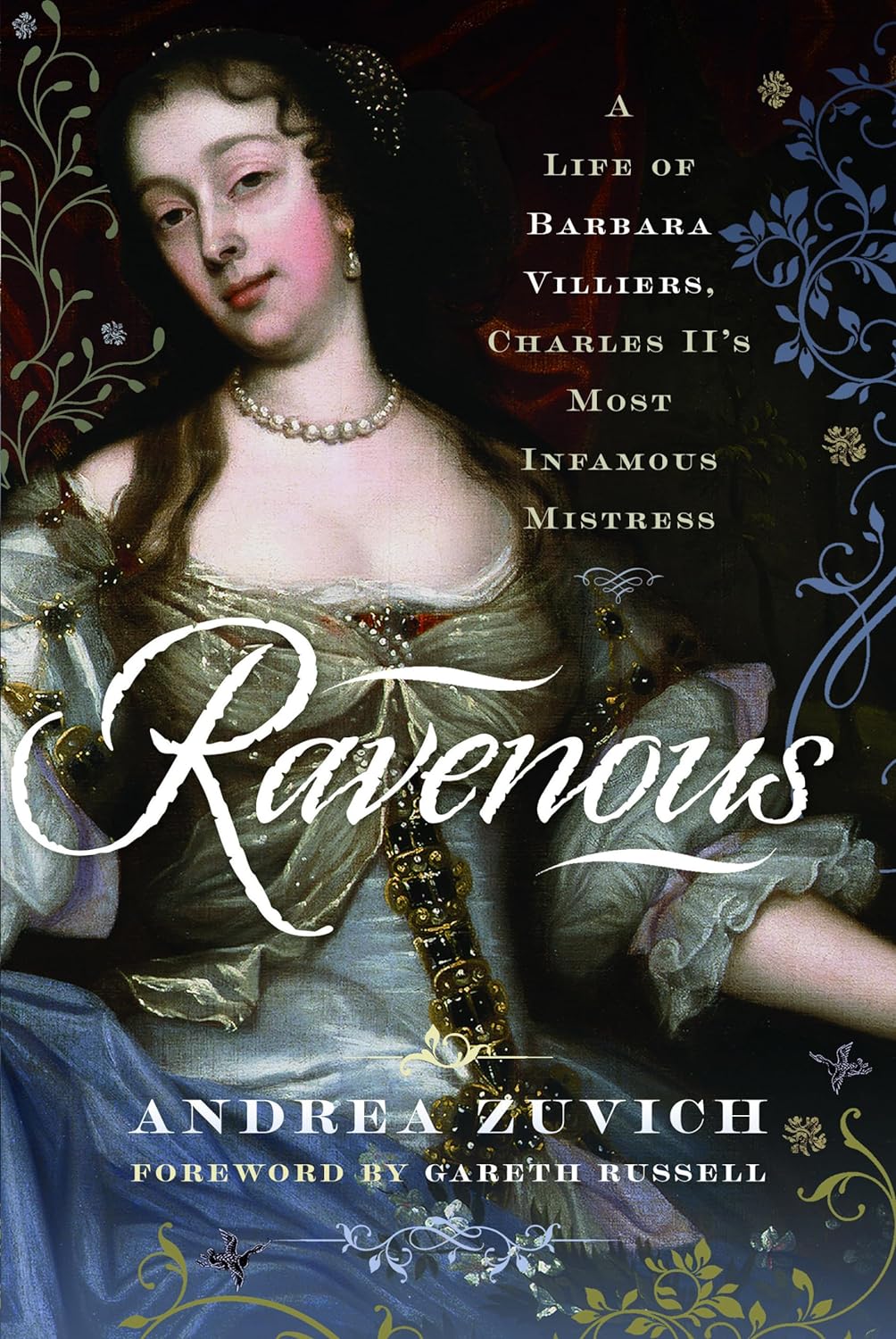
Book Review: “Ravenous: A Life of Barbara Villiers, Charles II’s Most Infamous Mistress” by Andrea Zuvich

My good friend and historian Andrea Zuvich kindly provided me with a copy of her latest book “Ravenous” which I was happy to read and review. As the title infers, Villers is not a very sympathetic or even likable character. Zuvich’s treatment of Barbara is very even handed, neither extolling her character nor denigrating her in the process. By providing the complex details of Barbara’s life, we get a complete view of her.

Barbara’s family, the Villiers, were integral operators in the Stuart monarchy beginning with the reign of James I. Zuvich gives us some background into the family, and Barbara was related to one of the more minor family members. From the time she was a teenager, she engaged in carnal relations with an aristocratic member of the court. Although this relationship did not result in a marriage, Barbara had a connection with the man throughout her whole life. Early on, Barbara managed to gain access to King Charles II, even while he was in exile and before his restoration to the English throne. By the time this happened, she was Charles’ maîtresse en titre, in the tradition of his grandfather, King Henri IV of France.

This would be Charles II’s longest lasting relationship, especially due to the birth of several children with Barbara, in effect creating a family unit which he supported until his death. Initially, Barbara engaged in political and diplomatic matters at court and as Zuvich explains, played a role in the disgrace of Henry Hyde, Charles’ chancellor, among others. Charles endowed Barbara with various sizable sources of income, something people grumbled about. He also elevated her, first to the title of Countess of Castlemaine and later to the title of Duchess of Cleveland. All of their male children together were given aristocratic titles and the female children made good marriages.

Later in her life, Barbara engaged in behavior, such as taking lovers and gambling large amounts of money which caused embarrassment for Charles, and she slowly disappeared from any meaningful influence and authority at court. Zuvich has found numerous references to debts and lawsuits for collection in Barbara’s name that make for interesting reading. I especially liked Andrea’s take on the relationship between King Charles and his wife, Queen Catherine of Braganza. She is very fair in her treatment of the queen.

Andrea’s research is meticulous, and she obviously went to great lengths to explore the archives to find intriguing nuggets about Barbara’s life. She also investigates and reports on all the many interrelationships between Barbara Villiers and numerous members of the Restoration Court. There is an extensive collection of illustrations in the book, documenting Barbara’s beauty throughout her life. The book is well written and well-researched. For anyone interested in the Barbara and various intrigues and dealings and interactions between courtiers of the Stuart Restoration court, I can highly recommend “Ravenous”.

For US buyers: Ravenous: A Life of Barbara Villers, Charles II’s Most Infamous Mistress

For UK buyers: Ravenous: A Life of Barbara Villiers, Charles II’s Most Infamous Mistress

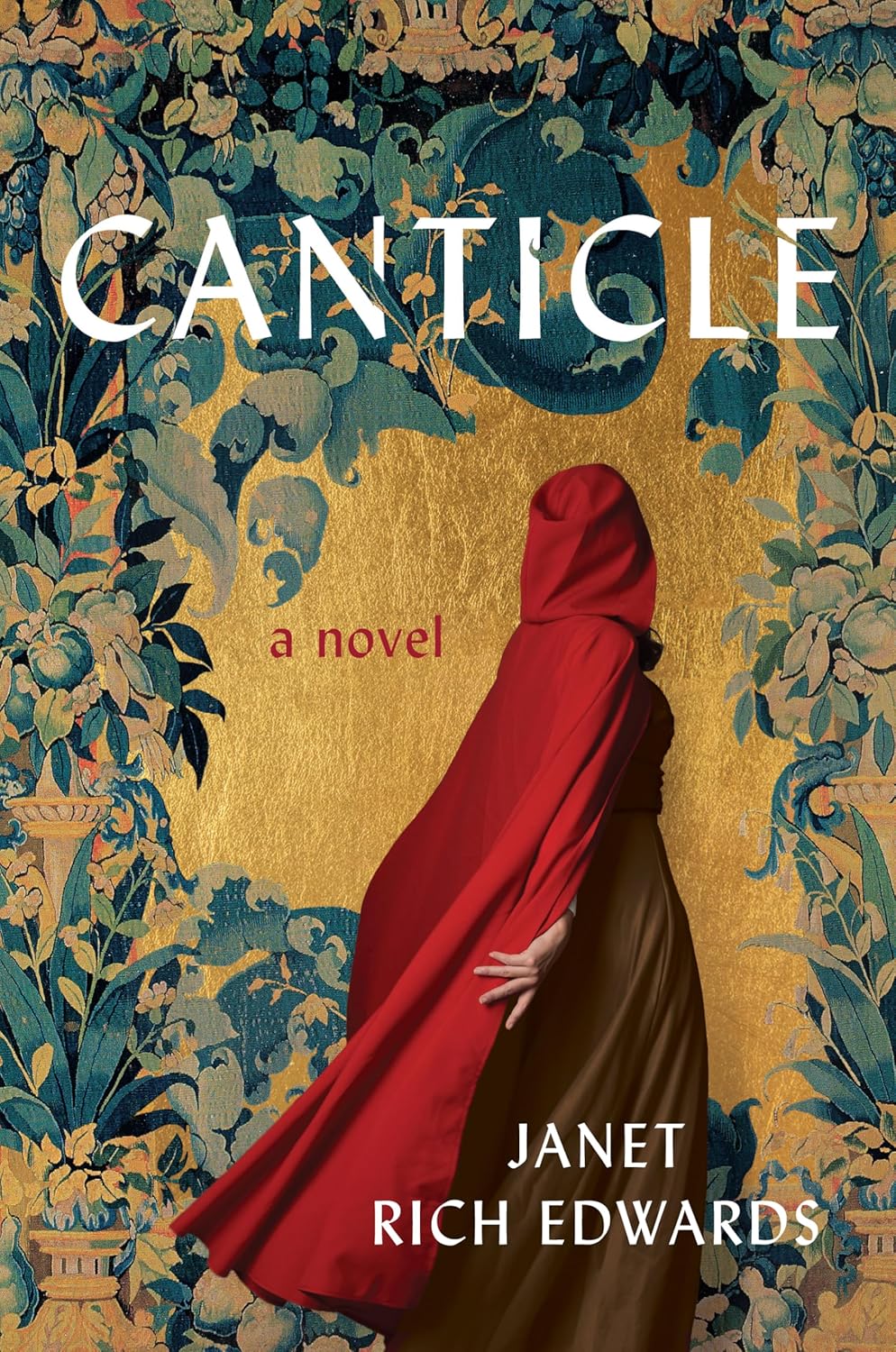
Book Review: “Canticle” by Janet Rich Edwards ~ A guest review by Eric Boss

Set in the 13th century and in the city of Brugge (Bruges) this complex novel of faith, fairness, hypocrisy and the plight of women in a world of men fills in many voids in the contemporary understanding of the role of female mystics and the place of women in the church. Although much is known about the beguines, a sect of female monks prevalent in Europe during the years before Protestantism took hold, the intimate personal view revealed here touches close to the emotional life of these remarkable people.

Aleys is a young girl born to a family of wool merchants who is visited by visions of a divine source urging her to find her way to God. The images she sees are bright, compelling, frightening and profound. When she voices a wish to become part of the Franciscan order her family is taken aback, since she has agreed to marry into a house of wealth that will assure her father a place in the guild he desperately seeks. Lukas, a Franciscan friar becomes her mentor although he is perplexed that she, a mere girl, should be privy to such holy calling when his own dedication and fervor have left him without such divine inspiration. Through a series of miracles Aleys performs and the devious machinations of the local bishop, a jealous and avaricious man who is more concerned with his own promotion within the church than real religious matters she is made an anchorite, sequestered from life in a cell attached to the local church.

How Aleys deals with not only the passionate response of the people of Brugge but the plots devised by the bishop is the meat of the story. It is an intimate look at the joy and sorrow of the true prophet, blessed and cursed with vivid images and an emotional bonding with Jesus, Mary and God. A thread dealing with the clandestine translation of the gospel into Dutch for the benefit of common folk who have only had access to the words of the Bible through priests who often did not understand the Latin or the meaning of the verses complicates the lives of Aleys, the beguines, and Lukas, her tortured mentor.

An understanding of the genesis of saints and martyrs who dominated much of the religious thought of the time is available to the reader who wishes to understand more about Christianity, women and the Church. A potent narrative illuminating the rapture and the pain of the zealots who often found themselves at odds with the established keepers of the faith is limned with skill and clear evidence of extensive research and soul-searching on the part of this author who is an academic as well as a novelist.

Shelf Talker: An intimate look into the lives of religious visionaries who became martyrs and saints as well as the intriguing sect of the beguines, a female sect of monks could easily be the basis of a course on women’s issues and/or comparative religion. Well written, compelling narrative and a gripping personal story of a young girl’s transformation from common to divine.

Book Review: “The Royal House of Braganza” by Francis Gribble

In searching for books on the royal House of Braganza, this title surfaced. Originally published in 1915 and reissued in 1970, it appeared to be just what I was looking for and turned out to be a complete surprise. I had never heard of Gribble before. I’m unable to find much information about him other than he was born in Barnstaple in the United Kingdom, he lived from 1862 to 1946 and is described as a writer, critic and a prolific literary biographer.

He has a pretty extensive body of work having written biographies of Honoré de Balzac and Emperor Francis Joseph as well as books on the lovers of Lord Byron, Georges Sand, Madame de Stael, and Chateaubriand and his court of women, among others. Curiously, he wrote a great deal about women in history, appearing to specialize in the topic. This is evident in this volume as he describes the women of the House of Braganza as the “men” in the family and writes admiringly of them.

I’m not sure how historically accurate this book is. However, I will say this. It’s a great read. Gribble’s sole purpose for writing this book is to explain the fall of the Portuguese monarchy and how the personalities of the monarchs themselves contributed to their demise. Gribble obviously doesn’t think much of the monarchs of the Braganza dynasty and he tells some pretty fantastic stories. He seems to take great delight in describing the physical appearance of these monarchs, how they dressed, their mannerisms and their personalities, their mistakes and their foibles. This really makes for some fun reading and I found myself laughing as I read it.

Gribble begins and ends the book with the tale of a Parisian dancing girl and her relationship with Dom Manuel II, the last monarch of the dynasty. While this poor woman was not the sole reason for Manuel being chased from the Portuguese throne, she is described as a catalyst. Gribble wrote this book a mere five years after Portugal became a republic so he has a cogent and immediate perspective on events. From reading other histories of Portugal, Gribble’s description of the intellectuals of the University of Coimbra (think the Philosophes of the French Enlightenment) and their proposals and conspiracy to form a republic is very well described and accurate. As I say, I’m not sure about the accuracy of the history of the kings themselves here but I really enjoyed this book. If anyone out there knows of this work and can vouch for its correctness, please leave a comment below.

Book Review: “Game of Queens” by Sarah Gristwood

It isn’t very often you come across a book that is nearly perfect in execution but this one fits the bill. Gristwood had done her homework in researching the history of these women, creating a most enjoyable read. The subtitle of the book is “The Women Who Made Sixteenth-Century Europe”. Her premise is the game of chess and she relates a myriad of women to the game and how it played out in the politics of the sixteenth Europe.

There were several women who emerged to rule in Europe during this period, either as regents, queen consorts or outright queen regnant. Many of readers favorite women are portrayed here: Katherine of Aragon, Anne Boleyn, Margaret Tudor, Mary Queen of Scots, Margaret of Austria, Queen Mary I and Elizabeth I of England, Louise of Savoy, Anne of Brittany, Queen Claude of France, Catherine de Medici, Marguerite of Valois, Queen of Navarre and her daughter Jeanne d’Albret, Margaret of Parma, Mary of Hungary and my personal favorite, Anne de Beaujeu. Many of the women are interconnected. Anne de Beaujeu schooled Margaret of Austria and Louise of Savoy in politics and government. She wrote a book for her own daughter, Suzanne de Bourbon called “Lessons for My Daughter” that Gristwood quotes from liberally and which carries a lot of good advice for all of these women. Anne Boleyn served at the court of Margaret of Austria. Gristwood recounts how all of these stories are interrelated.

While I am familiar with most of these women’s stories, there were a few that were new to me. I really enjoyed Gristwood’s take on Margaret Tudor, Queen of Scots. She has some great insight into Margaret’s personality. Some new territory for me were the stories of Mary of Hungary and Margaret of Parma who succeeded Margaret of Austria as Regent of the Netherlands for the Holy Roman Emperor Charles V. These women had a very difficult task, especially after the enormous social upheaval created by the Reformation. The story of Jeanne d’Albret, daughter of Marguerite, Queen of Navarre is most intriguing with the twists and turns of her marriages and her feisty defense of Protestantism.

By quoting letters and chronicles, Gristwood gives us a glimpse of all these women’s personalities allowing them to come to life. In addition to being beautifully written, this book has some nice accompaniments. There are genealogical tables, a list of dramatis personae, a section of lovely color photos and a chronology of events. Gristwood gives a nicely chosen bibliography for more in-depth reading. I cannot recommend this book enough. This is Sarah’s best work yet.

Book Review: “Golden Age Ladies” by Sylvia Barbara Soberton

Golden Age ladies book cover

The subtitle of this book is “Women Who Shaped the Courts of Henry VIII and Francis I”. Since I’m interested in women and Tudor and French history, I had to read it! England and France have a significantly entwined history. The book doesn’t disappoint as it has a panoply of women, explaining how their stories are all interrelated.

All the important women of these two courts make an appearance. Soberton gives us a list of characters for France and England along with genealogical tables. Interestingly, she starts out with Louise of Savoy, mother of King Francis I who learned statecraft from the formidable Anne de Beaujeu. Now here is a woman who witnessed so much history. The devoted mother of King Francis and his sister Marguerite, Queen of Navarre, Louise virtually ran the government of France while her son whiled away his time pursuing pleasures such as the hunt, women and warfare. Louise’s shining moment came when the Ladies Peace of Cambrai was negotiated in 1529 between her and her sister-in-law Margaret of Savoy, Regent of the Netherlands. The two women single-handedly brokered peace between France and the Habsburg Empire and Louise secured the release of her grandsons who had been held hostage. A marriage between King Francis and the Holy Roman Emperor’s sister Eleanor was part of the Ladies Peace. Her sad story is also included here.

Along with Louise and her daughter, we meet Queen Anne of Brittany and Claude de Valois and her many daughters, some of whom died and some who became Queen’s themselves, such as Madeleine de Valois. Interwoven with the lives of these French women are those from the court of King Henry VIII of England. Henry’s sister Mary married King Louis XII of France. Although she was queen for a few months, she went on to make a love match with her brother’s best friend, Charles Brandon, Duke of Suffolk.

Soberton gives us a description of the grand summit of The Field of the Cloth of Gold where Queen Catherine of Aragon met Queen Claude. Of course Anne Boleyn plays a significant role in the book as she spent time with Margaret of Savoy at her court in Mechelen and also worked as a lady-in-waiting for Queen Claude. In fact, Soberton gives us an economical description of all of Henry’s wives.

Soberton gives us many descriptions and small glimpses of personal moments in these women’s lives. This is what I liked best about the book. She has obviously done her research. There are photographs and a nice select bibliography if you are interested in more information. I found this book fun to read and enjoyed all the interconnecting stories. I highly recommend it.

Book Review: “The Warrior Queens: The Legends and the Lives of the Women Who Have Led Their Nations in War” by Antonia Fraser

The warrior Queens Fraser

Before there was Alison Weir, Philippa Gregory, and other contemporary women historians and writers, there was Antonia Fraser. Many years ago, in her heyday, I read everything she wrote that I could get my hands on. There was “Mary, Queen of Scots, “The Six Wives of Henry VIII”, “King Charles II” and a biography of Marie Antoinette, among others. Her non-fiction books were the gold standard of history. But somehow I missed “The Warrior Queens”.

I’ve always been fascinated by the story of Boudica, the Celtic queen of the Iceni tribe who rose up in rebellion against the occupying Romans in Britain in the mid-first century. I had heard she burned London to the ground! What an amazing story. I had to learn more. Apparently, Fraser felt the same way. The writing of this book was born out by her love of the story of Boudica. Most of the book is dedicated to Boudica’s story, relating it to the lives of other women who led their nations in war. Many of the women in this book I have heard of such as Matilda, Countess of Tuscany, the Empress Matilda of England and her cousin King Stephen’s wife Matilda of Boulogne, the twelfth century Georgian Queen Tamara, Isabella of Castile, and Queen Elizabeth I of England. These are some of my favorite women of history.

Fraser gives us the story of these women leading their troops into war in her inimitable intellectual manner which is very compelling. Her history is fair and balanced, engaging and fun. Her historical arguments make good sense. I especially found the story of the Rani of Jhansi to be captivating. She led her troops against the British during the Indian Rebellion of 1857. I knew nothing about her so it was refreshing to learn of her convictions and bravery.

Her final subjects are Golda Meir and Margaret Thatcher. It is interesting to see Fraser’s perspective on these modern women and their role in war. This book is women’s history at its finest. I can’t recommend it enough. I couldn’t put it down.