Book Review: “Margaret of Anjou: Queen of England” by Philippe Erlanger

erlanger-book-cover

In my research into the queens of England, I’ve been looking for a conventional biography of Margaret of Anjou. A contemporary biography of her doesn’t exist. This one was first published in 1961 in French under the title of “Marguerite D’Anjou et La Guerre Des Deux Roses” (Margaret of Anjou and the War of the Two Roses). This English version was published in 1970 and translated by Edward Hyams. Erlanger was a well-known French biographer who wrote many historical books before passing away in 1987. Just as an aside, he was the originator of the idea of the Cannes Film Festival which began in 1939.

Erlanger says in his introduction: “Nearly five centuries after her death an impartial Frenchman, brought up in his country’s traditions, but who is a friend and admirer of England, has tried, using modern methods, to review the indictment whereby posterity tried Henry VI’s fascinating queen, and ultimately condemned her.” I have to say I enjoyed reading a French writer’s view of English history!

At times this book reads like a novel and at other times like true history. Because this book was written in the 1960’s, he pretty much condemns Margaret as having taken many lovers. This has largely been disproven by now as propaganda from her political enemies. If you can get past this, the narrative is enjoyable. The first part of the book covers Europe in 1430 and then describes Margaret’s upbringing by her grandmother Yolande of Aragon at the court of Anjou. This pretty much sets the stage for Margaret’s extraordinary knowledge of statecraft that should have served her well in England during the chaos of her husband’s reign. However, she was a woman and she was French so her tactics didn’t have too much influence over the warring nobles of her husband’s court.

The author goes into great detail about Margaret’s life and the politics of England. There are some photos in the book and some genealogical tables, a limited bibliography but no index. As mentioned, if you can get past some of the historical flaws and drawbacks in the book, I highly recommend it. It will give the reader a better understanding of the Wars of the Roses and the uncommon life of this queen.

Book Review: “The Medieval and Post-Medieval Image of Eleanor of Aquitaine” by Michael R. Evans

inventing-eleanor-book-cover

Everybody loves Eleanor of Aquitaine. But did you know there are a lot of myths and legends that surround her story? Michael Evans has studied all the evidence from primary sources forward in an effort to find the real story of this popular Queen.

Evans begins by saying the actual evidence of Eleanor’s life is scarce and a lot of it is written by chroniclers hostile to her politically. He also argues that she is not any more extraordinary than any other medieval woman of her time based on the historical evidence. He then recounts the two categories of stories about her: the Black Legend and the Golden Myth.

The Black Legend myths include how she killed the fair Rosamund Clifford, mistress of King Henry II and the stories of her alleged incest with her uncle Raymond of Toulouse. He tells how the legend of the murder of Rosamund first appeared and then grew hugely out of proportion. The evidence of the incest is negligible but it was common practice to blacken a powerful woman’s name with tales of sexual misconduct.

The Golden Myth includes the stories of Eleanor dressing as an Amazon to go on Crusade and how she and her daughter Marie presided over scenes of courtly love in Poitou. Both of these myths were debunked a long time ago but he shows how they got started and continued to have life in books and literature. (For more on the legends surrounding Eleanor’s life, click here.)

There is quite a bit in the book about how Eleanor has appeared in literature, fiction and non-fiction, on stage, in the movies and on television. Katherine Hepburn in “The Lion in Winter” is especially commended in her portrayal of Eleanor. Anyone who is interested in Eleanor will not be disappointed in this book. It sheds an eye-opening light on her story. It is my opinion that Eleanor’s life was remarkable even without the legends.

Book Review: “Tales of the Marriage Bed from Medieval France (1300-1500) by R.C. Famiglietti

couple-in-bed-in-illuminated-manuscript

This book was listed as a reference which I found while researching Isabeau of Bavaria, Queen of King Charles VI of France. I happened to find a used copy of the book although it wasn’t cheap. There is an interesting section on her in which he describes her as the “perfect wife”. I decided to read the whole book.

Published in 1992, this is one of the best books I’ve read recently. I love French history. What makes this book unique is it delves into the lives of the people of France, from royalty down to ordinary people. It’s more of a social history. Most of the stories related deal with the nobility including the petty nobility. As it states on the book cover, “The vignettes, episodes in the lives of married couples, allow us to observe the vast panorama of life in medieval France and to explore the mores, attitudes, and concerns of the time.”

Sections of the book deal with the following topics: incest, choosing a mate, negotiating a marriage, weddings, elopements and abductions, mistresses and bastards, adultery, abuse, murdering a mate, the perfect husband and the perfect wife. Some of these tales are gruesome. In some of these instances, there were court cases brought to justice. This gives Famiglietti a chance to describe the workings of the justice system in medieval France. These stories definitely give us a glimpse of the status of women during this time period and it certainly isn’t pretty.

I especially liked the description of a wedding in Bordeaux in 1460. One episode relates a ghastly tale of a wife being murdered by her husband. There’s a long drawn out case of incest in the fourteenth century. There’s a description of a marriage where the husband beat his wife and one where the wife was kept locked up in a tower. All of these are true tales which Famiglietti found in historical sources.

This book has a map of medieval France, an extensive bibliography, sixty-eight black and white plates depicting some of the characters in the stories along with extensive explanations for the illustrations. This book is well researched, well written and fascinating to read. Famiglietti also wrote a book about royal intrigue during the reign of King Charles VI. I’m looking for a copy of that one for a reasonable price.

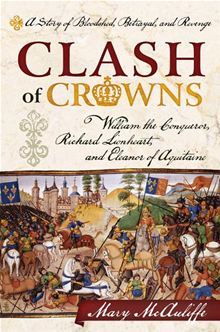
Book Review: “Clash of Crowns” by Mary McAuliffe

clash-of-crowns-book-cover

Found this book while browsing at the local bookstore. It looked pretty interesting. The subtitle is “William the Conqueror, Richard Lionheart, and Eleanor of Aquitaine” and at the top of the cover it says “A Story of Bloodshed, Betrayal, and Revenge”. Sounds great doesn’t it?

Well, it is. McAuliffe obviously has a great passion for this era of French and English history. The book was inspired by the great fortification Château-Gaillard in France which was built by Richard the Lionheart during his clashes and wars with Philip Augustus II, King of France. She uses this castle to tell the story of Richard, beginning with the Viking Rollo, the first count of Normandy. The story progresses down to Rollo’s descendant William the Conqueror who became King of England in 1066.

William’s grand-daughter, Empress Matilda should have been Queen of England when her father King Henry I of England died. But her cousin Stephen got to England first causing the period of strife called the Anarchy while Matilda and Stephen fought for the throne. Eventually, Matilda’s first born son by Geoffrey of Anjou became King Henry II. Henry married Eleanor of Aquitaine and had several sons who rebelled against their father.

All of this is recounted in this book in the context of European medieval history. McAuliffe brings all of these historical characters to life with all their admirable qualities and their foibles. She gives a detailed description of the fighting between Lionheart and Philip Augustus. Lionheart built the magnificent and modern fortress of Château-Galliard to safeguard a crucial point of defense in an effort to maintain possession of the duchy of Normandy. The castle was called Richard’s “Proud Daughter”. The final attack and siege of the castle by Philip is described in detail. It makes for fascinating reading.

Anyone who loves English and French medieval history will enjoy this book. It is well organized, and researched and well written. It includes a bibliography, illustrations, maps, a chronology and a list of key people in the story. Even if you know the history it’s a fun read and if you don’t, it’s a great introduction.

Book Review: “Margaret of Anjou: Queenship and Power in Late Medieval England” by Helen E. Maurer

Margaret of Anjou Maurer book cover

In the course of my research on English queens, I searched for a biography of Margaret of Anjou, the wife of King Henry VI. There appears to be no contemporary biography of her which in itself is interesting but I did find this book. It’s not a recounting of her life in a biographical sense however but a thought provoking examination of Queenship and power in medieval England.

The author says she was introduced to Margaret of Anjou by seeing a performance of a Shakespearean play in Central Park in New York City. Later, while studying in school for a doctorate, she found an article where an historian called for an examination of Margaret’s role in the political upheaval in England now known as the Wars of the Roses. She ended up writing this book.

This is not an easy read as it is definitely an academic exercise. She describes the role of a medieval queen in many different spheres such as motherhood, intervention and mediation, and aiding her retainers. A medieval queen, especially one of foreign origin, could never rule directly. Any influence she had would be through her husband the king.

Maurer tells us about Margaret’s upbringing which in many ways was extraordinary. She was highly educated and due to the influence of her formidable grandmother Yolande of Aragon, learned statecraft. Her marriage to King Henry VI came with great expectations of peace between England and France after the devastation of the Hundred Years War. When Margaret came to England as a teenager, her entrance into was celebrated with hopeful allegory. Maurer gives us a long description of these celebrations.

It was only after Margaret bore a son that she started to come into her own. At the same time of her pregnancy, her husband succumbed to madness throwing the government of the realm into chaos. Margaret did what she could to preserve the power of her husband and secure the interests of him, herself and her son, working within the boundaries of a medieval queen. Despite her best efforts, there was infighting and backstabbing among the nobility who were doing the best they could to preserve their own self interests.

In the end, Margaret became the figurehead of the House of Lancaster and even led her own troops. This was not really within the realm of the powers of a medieval queen as Maurer argues here. For better or worse, Margaret did the best she could and ended up losing everything. She just couldn’t overcome the restrictions placed on her as a medieval queen.

Maurer makes some very cogent and logical arguments here. She has some insight into the men Margaret was up against in her fight to preserve the power and prestige of her family. As stated, if you are looking for a conventional biography, this book isn’t it. But I would still recommend it if you have an interest in medieval royal women’s position, function and responsibility in history.

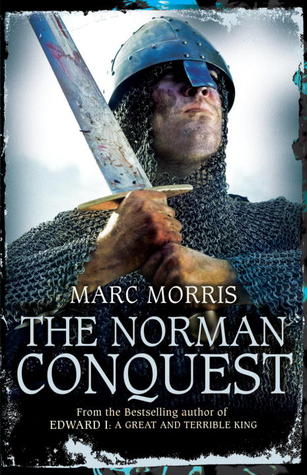
Book Review: “The Norman Conquest” by Marc Morris

Norman Conquest Book Cover

I have several books written by Marc Morris on my “to read” shelf and hadn’t managed to read any of them until now. In my quest to read French history this summer I picked up this book. The subject is all the more interesting because it combines French history with English history and what could be better than that? Another reason I was interested is I’ve always wondered how William Duke of Normandy prepared for the conquest. What actually went into the planning of the expedition?

I have to start out by saying Morris’ writing style is really tremendous. His prose is fluid and easily understandable. He has closely studied all the conflicting sources and made comparisons to arrive at this own conclusions. This is historical detective work at its best.

The early chapters cover the period of Anglo-Saxon history before William arrives. Here we meet Aethelred the Unready, Queen of Emma of Normandy, King Cnut, Harthacnut and Harold Harefoot, Edward the Confessor, Queen Edith of Wessex and the powerful Earl Godwine and King Harold. These historical characters are so compelling I just can’t read enough about them. Morris sets up the scene here for the big battle.

My search for William’s preparation plans has been fulfilled. Morris goes into great detail on how William persuaded the Pope to back his mission, how he gathered an army of followers with promises of great rewards, his search for a naval flotilla to take the army to England and how he provisioned the troops. Morris also describes how King Harold kept vigil awaiting the invasion, then stood down only being forced to gather his army again to fight against an invasion by King Harald Hardrada of Norway and his own brother Tostig Godwineson. Three weeks later William invaded and King Harold was defeated at the Battle of Hastings on October 14, 1066.

Based on what little information there is on Hastings, Morris does an excellent job of describing the battle itself. The rest of the book recounts the reign of the Conqueror and how it affected England on a political and social level. Morris tells of the rebellions William had to suppress in England and in Normandy along with the dysfunctional dynamics of his own family. Morris is very fair in describing the good points and the bad points of William’s personality and style of medieval government and how devastating and transformative his conquest was on Anglo-Saxon England.

I really enjoyed the description of how William ordered the Domesday Survey in England, how writing it was accomplished and what the purpose of the survey entailed. This was new information for me and very informative. I cannot recommend this book enough. And now I must read more of Morris’ work!

Book Review: “Golden Age Ladies” by Sylvia Barbara Soberton

Golden Age ladies book cover

The subtitle of this book is “Women Who Shaped the Courts of Henry VIII and Francis I”. Since I’m interested in women and Tudor and French history, I had to read it! England and France have a significantly entwined history. The book doesn’t disappoint as it has a panoply of women, explaining how their stories are all interrelated.

All the important women of these two courts make an appearance. Soberton gives us a list of characters for France and England along with genealogical tables. Interestingly, she starts out with Louise of Savoy, mother of King Francis I who learned statecraft from the formidable Anne de Beaujeu. Now here is a woman who witnessed so much history. The devoted mother of King Francis and his sister Marguerite, Queen of Navarre, Louise virtually ran the government of France while her son whiled away his time pursuing pleasures such as the hunt, women and warfare. Louise’s shining moment came when the Ladies Peace of Cambrai was negotiated in 1529 between her and her sister-in-law Margaret of Savoy, Regent of the Netherlands. The two women single-handedly brokered peace between France and the Habsburg Empire and Louise secured the release of her grandsons who had been held hostage. A marriage between King Francis and the Holy Roman Emperor’s sister Eleanor was part of the Ladies Peace. Her sad story is also included here.

Along with Louise and her daughter, we meet Queen Anne of Brittany and Claude de Valois and her many daughters, some of whom died and some who became Queen’s themselves, such as Madeleine de Valois. Interwoven with the lives of these French women are those from the court of King Henry VIII of England. Henry’s sister Mary married King Louis XII of France. Although she was queen for a few months, she went on to make a love match with her brother’s best friend, Charles Brandon, Duke of Suffolk.

Soberton gives us a description of the grand summit of The Field of the Cloth of Gold where Queen Catherine of Aragon met Queen Claude. Of course Anne Boleyn plays a significant role in the book as she spent time with Margaret of Savoy at her court in Mechelen and also worked as a lady-in-waiting for Queen Claude. In fact, Soberton gives us an economical description of all of Henry’s wives.

Soberton gives us many descriptions and small glimpses of personal moments in these women’s lives. This is what I liked best about the book. She has obviously done her research. There are photographs and a nice select bibliography if you are interested in more information. I found this book fun to read and enjoyed all the interconnecting stories. I highly recommend it.

Book Review: “Paris, 1200” by John W. Baldwin

Paris 1200 book cover

I love French medieval history so this book looked like it was right up my alley. John W. Baldwin is Charles Homer Haskins Professor Emeritus of History at Johns Hopkins University and has written many books on French history. This particular book was originally published in French in 2006. It was so popular, Stanford University Press decided to publish it in English in 2010.

Using sources only for the years 1190 to 1210 gives Baldwin a laser like focus on this seminal year. Construction of Notre Dame and the great wall of King Philip Augustus was underway. Pope Innocent III put the royal domains under interdict in January because the king had tried to put aside his lawful wife, Ingeborg of Denmark. This uncomfortable state of affairs for the ordinary people lasted for nine months. The churches were closed, no weddings or burials were performed, no mass was celebrated and no confession was allowed. King Philip made an important treaty with King John of England and the students of Paris threatened to go on general strike to protest infringements of their rights.

Baldwin gives us an interesting perspective on certain personalities of this time period such as the bourgeoisie who played a role in the king’s government, the working poor, the prostitutes, the king, Pierre the Chanter who directed the choir of Notre Dame and other women of the city. He tells us how the city was provisioned, who the merchants were, the use of currency and credit, and how trade was imperative to the economy of the city and France. There is an important chapter on the government of Philip Augustus. Before he went on Crusade, he set up a bureaucracy to rule in his absence and to collect taxes which was very successful.

Other sections of the book deal with the church, clergy and religious life and on the operation of the schools in the city. The details Baldwin gives on the schools is fascinating. He has gleaned from the documents who the teachers were, the subject matter they taught and what books they used. He even tells us who the students were, how they lived and especially how they got into a lot of trouble.

A final chapter deals with everyday life of the people of Paris. Baldwin gives details about the festivals people celebrated, how they worshiped at Christmas, the tournaments of the aristocracy, the joys of marriage, entertainment such as jongleurs and music, how the people spoke and swore and the art of love. All of this is very intriguing and really gives a feel for how people lived in the era.

There are some great photos in the book. Included are miniatures from illuminated manuscripts depicting everyday life and how the clergy lived and worshiped. There are photos of Notre Dame and a diagram of its choir. There is a map of Paris from 1200 and other maps and tables. I really enjoyed this book and learned a lot. I highly recommend it.

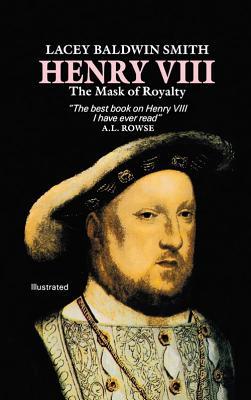
Book Review: “Henry VIII: The Mask of Royalty” by Lacey Baldwin Smith

Lacey Baldwin Smith's Mask of Royalty book cover

When I was a history major in college, probably in my senior year, I took my first psychology course. Psychology turned out to be a fascinating subject and made me think about how it could be applied to history. The thought of a course in psycho-history crossed my mind but unfortunately my school didn’t offer such a course! Little did I know at the time Lacey Baldwin Smith was writing his seminal work on King Henry VIII and that is was a masterful psycho-history biography.

Many people had recommended this book to me and it was gripping from the very first chapter. Smith begins with the dying king secluded in his chamber and describes the loyal servants around him and their behavior. As many Tudor history fans know, there may have been some shenanigans during the king’s fateful final illness, especially regarding his will. Smith explains that Henry had his full faculties up until the end, perhaps blissfully ignoring the fact he was dying. But we do know there were changes made to the will and it wasn’t signed by the king’s hand but with a dry stamp. All this is very intriguing.

The book then goes into flashback so to speak to around the time Henry married Catherine Howard and most of the book recounts the years from 1540 until his death in 1547. Smith explains how Henry was given an in-depth humanist education but he certainly wasn’t the most intelligent man at court. What he was good at was remembering many minute details of all the business of governing of the realm. There are many records with Henry’s own notes written by hand that still exist to this day.

There is a most interesting chapter regarding Henry and his thinking as Supreme Head of the Church in England. Henry’s conscience was responsible for the spiritual life of all his subjects. Smith gives us a most interesting insight into what a precarious position this was for Henry and how this affected his view of the church in his kingdom. Smith examines some of the foreign policy of Henry in the later years recounting the delicate dance of power between the Holy Roman Emperor Charles V and King François I of France.

Woven throughout Smith’s narration is how Henry’s psychological perspective and views of his place in the world influenced his reign. His insights go a long way in explaining why he did what he did in making decisions, marrying so many times and executing valuable servants. I found all of Smith’s arguments to be very absorbing and they gave me a deep understanding of not just Henry but the mindset of Tudor England overall. I couldn’t put this book down and was sad when I finished it. I can’t recommend it enough. Any reader will definitely have a better understanding of the standout king and his reign.

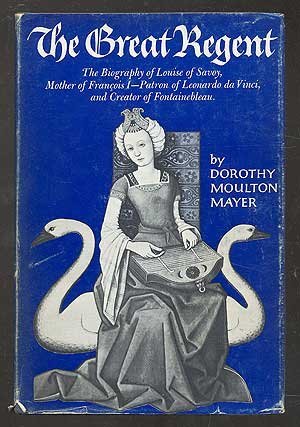
Book Review: “The Great Regent: Louise of Savoy, 1476-1531” by Dorothy Moulton Mayer

The Great Regent book cover

The difficult thing about researching and writing about French history can sometimes be finding sources when you don’t read the language. Completely by chance, I found this biography of Louise of Savoy in English and was thrilled. This book was written in 1966 and published by Funk and Wagnalls. The author herself has an interesting story.

Dorothy Moulton Mayer was an accomplished English singer. She married a German born philanthropist, Robert Mayer who was one of the founders of the London Philharmonic Orchestra. From the 1950’s on, Dorothy wrote several biographies including on Queen Marie Antoinette, painter Angelica Kaufman, violinist and composer Louis Spohr and this one on Louise of Savoy. I really have to admire her determination in writing these biographies.

Louise of Savoy was the mother of King François I of France. This in and of itself is not remarkable. What is significant is the fact that François trusted and relied on his mother so much that she basically ruled France from the time he took the throne in 1515 until her death in 1531. This served two purposes. François could continue to pursue his passions and pleasures such as hunting, conquering Italy and women. And secondly, Louise did an outstanding job when she was in charge of the government.

This can particularly be seen when François and his troops lost the Battle of Pavia in 1525 to the Holy Roman Emperor Charles V during the Italian Wars. François was taken prisoner and kept incarcerated in Spain until March of 1526. Louise was completely in charge in France and worked diligently to release the King. The Treaty of Madrid was brokered and François was released. However, in return he had to give up his two sons as hostages to Charles. Thereafter, Louise had to work even harder to get her grandsons released. She brokered the Treaty of Cambrai in 1529 along with her sister-in-law, Margaret of Austria who was acting on behalf of her nephew Charles V. This was called the Ladies Peace and Mayer gives a detailed description of the proceedings which is fascinating.

I really loved this book. Mayer’s writing is fluid and comprehensive. She gives lots of detail about the life of this remarkable lady including her upbringing under Anne de Beaujeu where she learned her craft and tidbits about her health. Her descriptions of her accomplishments are fair and balanced. Mayer talks about how historians have denigrated Louise’s actions and reputation. Mayer gives her own interpretations.

The book has a comprehensive bibliography of primary sources and there are some outstanding photos of contemporary art depicting Louise. And in the end there is a fascinating appendix. Mayer sent Louise’s handwritten letter to the Emperor Charles V after her beloved son King François was taken prisoner to a handwriting expert. She includes the expert’s interpretation of the writer’s personality. I think you will find the essence of Louise’s character it what he has written. Louise is a lady to admire and I highly recommend this book.