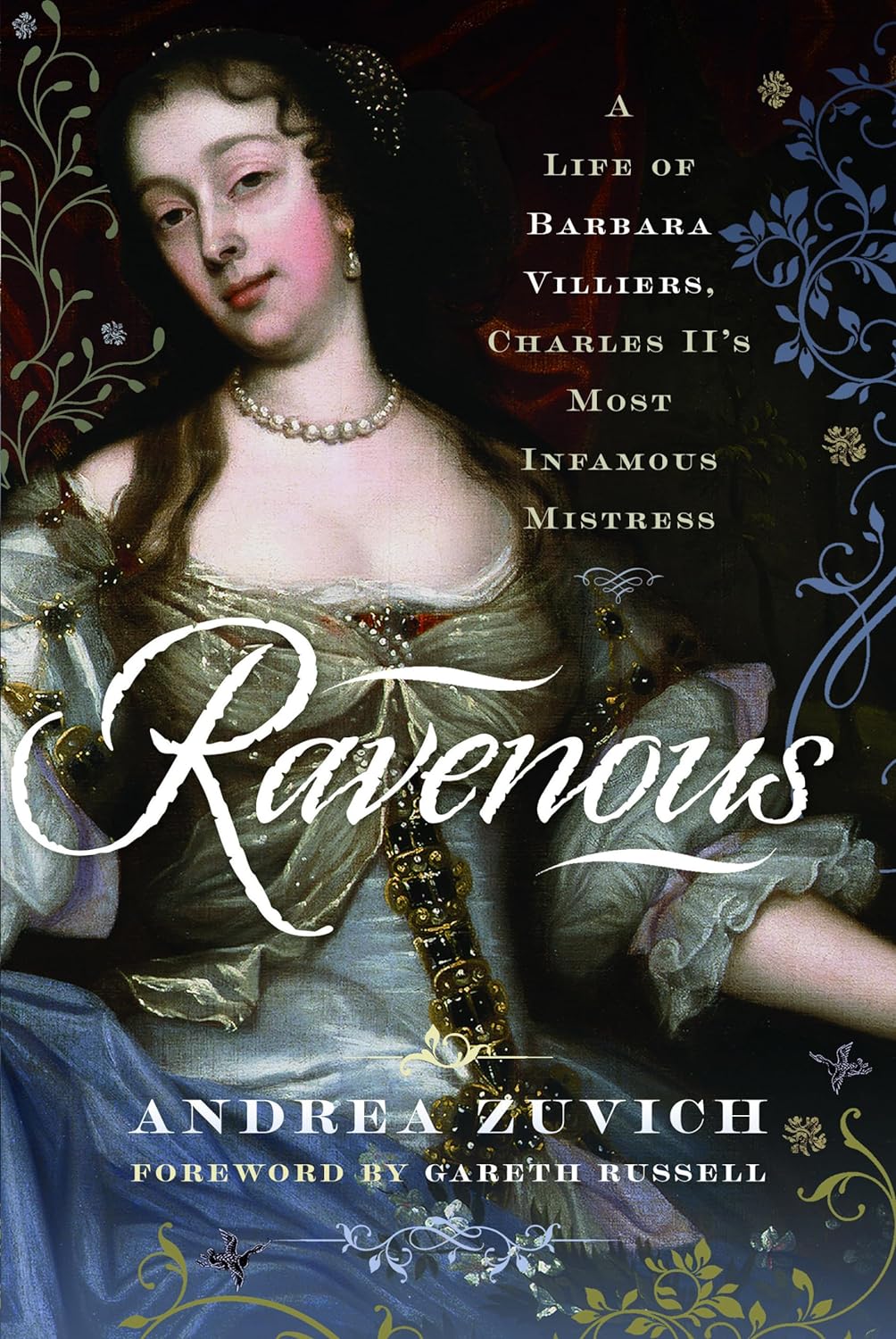
Book Review: “Ravenous: A Life of Barbara Villiers, Charles II’s Most Infamous Mistress” by Andrea Zuvich

My good friend and historian Andrea Zuvich kindly provided me with a copy of her latest book “Ravenous” which I was happy to read and review. As the title infers, Villers is not a very sympathetic or even likable character. Zuvich’s treatment of Barbara is very even handed, neither extolling her character nor denigrating her in the process. By providing the complex details of Barbara’s life, we get a complete view of her.

Barbara’s family, the Villiers, were integral operators in the Stuart monarchy beginning with the reign of James I. Zuvich gives us some background into the family, and Barbara was related to one of the more minor family members. From the time she was a teenager, she engaged in carnal relations with an aristocratic member of the court. Although this relationship did not result in a marriage, Barbara had a connection with the man throughout her whole life. Early on, Barbara managed to gain access to King Charles II, even while he was in exile and before his restoration to the English throne. By the time this happened, she was Charles’ maîtresse en titre, in the tradition of his grandfather, King Henri IV of France.

This would be Charles II’s longest lasting relationship, especially due to the birth of several children with Barbara, in effect creating a family unit which he supported until his death. Initially, Barbara engaged in political and diplomatic matters at court and as Zuvich explains, played a role in the disgrace of Henry Hyde, Charles’ chancellor, among others. Charles endowed Barbara with various sizable sources of income, something people grumbled about. He also elevated her, first to the title of Countess of Castlemaine and later to the title of Duchess of Cleveland. All of their male children together were given aristocratic titles and the female children made good marriages.

Later in her life, Barbara engaged in behavior, such as taking lovers and gambling large amounts of money which caused embarrassment for Charles, and she slowly disappeared from any meaningful influence and authority at court. Zuvich has found numerous references to debts and lawsuits for collection in Barbara’s name that make for interesting reading. I especially liked Andrea’s take on the relationship between King Charles and his wife, Queen Catherine of Braganza. She is very fair in her treatment of the queen.

Andrea’s research is meticulous, and she obviously went to great lengths to explore the archives to find intriguing nuggets about Barbara’s life. She also investigates and reports on all the many interrelationships between Barbara Villiers and numerous members of the Restoration Court. There is an extensive collection of illustrations in the book, documenting Barbara’s beauty throughout her life. The book is well written and well-researched. For anyone interested in the Barbara and various intrigues and dealings and interactions between courtiers of the Stuart Restoration court, I can highly recommend “Ravenous”.

For US buyers: Ravenous: A Life of Barbara Villers, Charles II’s Most Infamous Mistress

For UK buyers: Ravenous: A Life of Barbara Villiers, Charles II’s Most Infamous Mistress

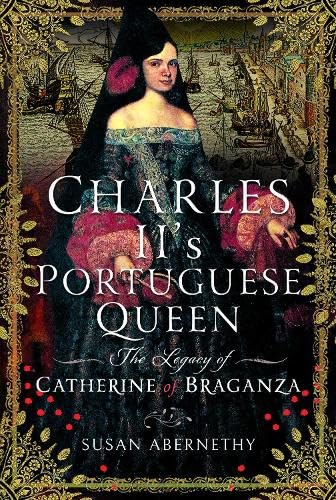
Book Deal: 25% off Charles II’s Portuguese Queen: The Legacy of Catherine of Braganza

Barnes and Noble US is offering members 25% of pre-orders until April 25, 2025. Order your copy of Charles II’s Portuguese Queen: The Legacy of Catherine of Braganza today for delivery on June 30th.

https://www.barnesandnoble.com/w/charles-iis-portuguese-queen-susan-abernethy/1147058576?ean=9781036121648

Charles II’s Portuguese Queen: The Legacy of Catherine of Braganza is now available for pre-order

Exciting News! The Freelance History Writer’s debut book Charles II’s Portuguese Queen: The Legacy of Catherine of Braganza is now available for pre-order. Click on the links below and order your copy today.

To order for shipping to the United States:

From Blackwell’s Booksellers

To order for shipping to the UK and elsewhere in the world:

From Amazon.co.uk

From Pen and Sword publishers

Book Review: “Charles II: King of England, Scotland and Ireland” by Ronald Hutton

Hutton Charles II book cover

This biography of the Stuart Restoration King Charles II was recommended by the author of another book I was reading for research.  He said it was the best biography on this king that he had found.  That was enough of an endorsement for me.

Mr. Hutton was a reader in History at the University of Bristol at the time of publication (1989).  This was ten years after Lady Antonia Fraser’s magnificent biography of Charles II was published.  Hutton’s book is completely different from Fraser’s although he gives her great praise for her work.  The difference is, Hutton relies entirely on primary sources to tell the story consisting mostly of letters.

This volume is an in-depth examination of the politics of the reign of Charles II, including Scotland and Wales.  While he covers the life of the king, it explains more about the men who surrounded him and helped him rule his three kingdoms.  If you are looking for personal details, Fraser’s book would be more relevant.  Hutton is looking for who surrounded the king, who gave him advice, and how did Charles make decisions.  The lives of the councilors can sometimes be as fascinating as that of the king.

This is not an easy read.  At times it was a little dry and some of the politics could be confusing.  It helps to have a working knowledge and background on the era.  But I found Hutton’s insight into the personalities of the king, queen, Charles’ mistresses and the men who surrounded him to be very absorbing.

The final chapter supplies the author’s conclusions upon the virtues, vices and achievements of Charles II.  He states he realized early on he was dealing with a legendary figure.  In constructing his view of Charles, he tried to use only what was said about him by his contemporaries and weed out the material that was apocryphal.  Hutton has done a remarkable job.  I now have an improved understanding of this king and his reign.


Book Review: “Catherine of Braganza” by Janet MacKay

Mackay Braganza book cover


I’ve been doing some research on the seventeenth century and found a used copy of this book, originally published in 1937.  MacKay wrote this twenty-nine years after Lillias Campbell Davidson wrote her definitive biography.  I have been unable to find any biographical information on MacKay, who authored one other book.

There are many primary sources documenting Catherine’s life.  MacKay’s writing is flavored with description and fantasy but overall she adheres to the historical truth.  I found Mackay has a considerable amount of insight into the personalities of Catherine of Braganza and King Charles II and it makes for interesting reading.

The first chapter on Catherine’s life is short, about twenty pages but this is the only part of Catherine’s life that is not well-documented.  The narrative then picks up momentum and describes the various negotiations regarding her marriage to Charles II, the newly restored Stuart King of England.  There’s a great description of Catherine’s leave-taking of her mother, her brothers and her beloved Portugal.  Once she is in England, her troubles begin with the difficult Lady Castlemaine and Charles’ insistence that she relent in allowing Castlemaine to become a Lady of the Bedchamber.

MacKay gives a succinct and compelling retelling of the Popish Plot which threatened Catherine’s life.  Although her time in England had its ups and downs, Charles stood by her the entire time.  She was devastated by his death in 1685.  Catherine remained in England another seven years and worked tirelessly to return to Portugal.  Her marriage contract allowed this but she had a difficult time getting a ship to take her home and some illness which delayed her.  Astonishingly, there are eighty letters written by Catherine in the British Library, many of them written to her brother regarding arrangements for her return to Portugal.  MacKay quotes these letters extensively to tell the story.

The last few years spent by Catherine in Portugal are well covered here.  The book has several portraits.  There is an adequate bibliography but it is poorly footnoted as many books were from this era.  Nonetheless, MacKay has written an insightful biography which I enjoyed very much.