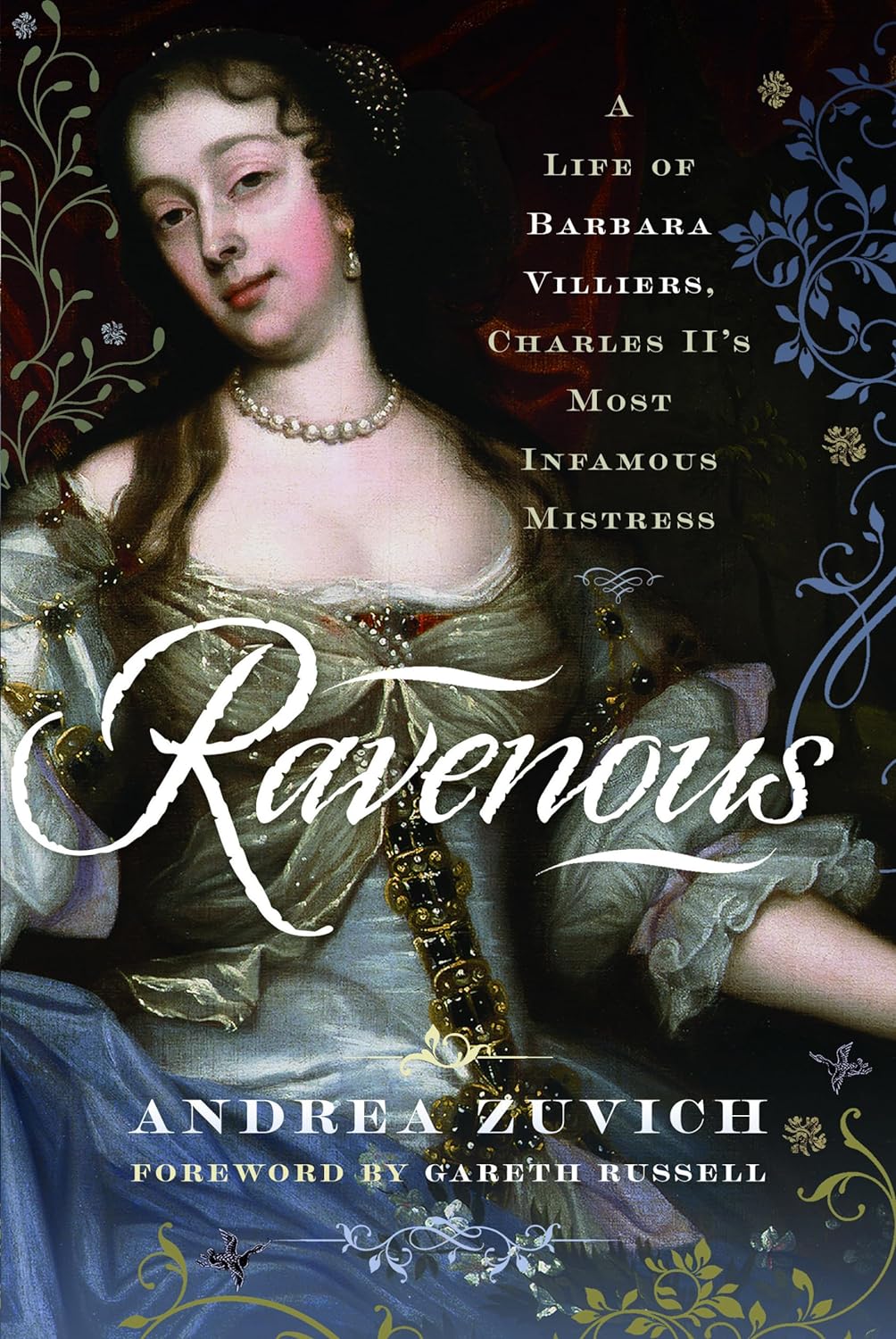
Book Review: “Ravenous: A Life of Barbara Villiers, Charles II’s Most Infamous Mistress” by Andrea Zuvich

My good friend and historian Andrea Zuvich kindly provided me with a copy of her latest book “Ravenous” which I was happy to read and review. As the title infers, Villers is not a very sympathetic or even likable character. Zuvich’s treatment of Barbara is very even handed, neither extolling her character nor denigrating her in the process. By providing the complex details of Barbara’s life, we get a complete view of her.

Barbara’s family, the Villiers, were integral operators in the Stuart monarchy beginning with the reign of James I. Zuvich gives us some background into the family, and Barbara was related to one of the more minor family members. From the time she was a teenager, she engaged in carnal relations with an aristocratic member of the court. Although this relationship did not result in a marriage, Barbara had a connection with the man throughout her whole life. Early on, Barbara managed to gain access to King Charles II, even while he was in exile and before his restoration to the English throne. By the time this happened, she was Charles’ maîtresse en titre, in the tradition of his grandfather, King Henri IV of France.

This would be Charles II’s longest lasting relationship, especially due to the birth of several children with Barbara, in effect creating a family unit which he supported until his death. Initially, Barbara engaged in political and diplomatic matters at court and as Zuvich explains, played a role in the disgrace of Henry Hyde, Charles’ chancellor, among others. Charles endowed Barbara with various sizable sources of income, something people grumbled about. He also elevated her, first to the title of Countess of Castlemaine and later to the title of Duchess of Cleveland. All of their male children together were given aristocratic titles and the female children made good marriages.

Later in her life, Barbara engaged in behavior, such as taking lovers and gambling large amounts of money which caused embarrassment for Charles, and she slowly disappeared from any meaningful influence and authority at court. Zuvich has found numerous references to debts and lawsuits for collection in Barbara’s name that make for interesting reading. I especially liked Andrea’s take on the relationship between King Charles and his wife, Queen Catherine of Braganza. She is very fair in her treatment of the queen.

Andrea’s research is meticulous, and she obviously went to great lengths to explore the archives to find intriguing nuggets about Barbara’s life. She also investigates and reports on all the many interrelationships between Barbara Villiers and numerous members of the Restoration Court. There is an extensive collection of illustrations in the book, documenting Barbara’s beauty throughout her life. The book is well written and well-researched. For anyone interested in the Barbara and various intrigues and dealings and interactions between courtiers of the Stuart Restoration court, I can highly recommend “Ravenous”.

For US buyers: Ravenous: A Life of Barbara Villers, Charles II’s Most Infamous Mistress

For UK buyers: Ravenous: A Life of Barbara Villiers, Charles II’s Most Infamous Mistress

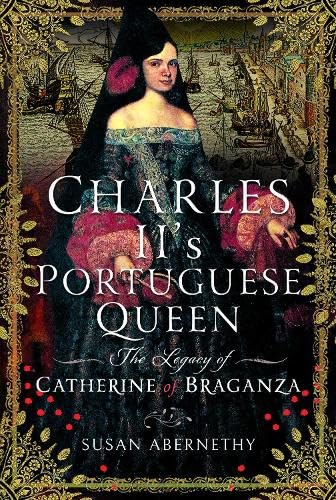
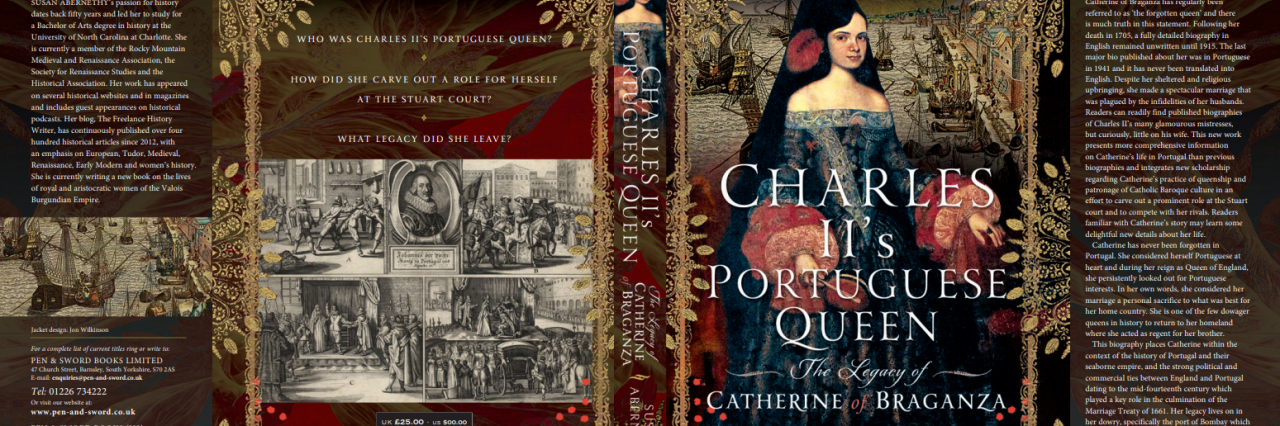
Discount available for Charles II’s Portuguese Queen: The Legacy of Catherine of Braganza

Blackwell’s now has copies of Charles II’s Portuguese Queen: The Legacy of Catherine of Braganza available and they are offering a 10% discount and free shipping to the US. This is the best price yet. Order your copy today!

Blackwell’s Bookseller

Amazon is also offering the book at a reduced price for pre-order to the US

Amazon.com Pre-Order

Book Review: “The Catskills: Its History and How It Changed America” by Stephen M. Silverman and Raphael D. Silver

The Catskills: Its History and How It Changed America

Having been a scholar of Western European history for many decades, I had managed to convince myself that American history was boring and not on the same level. Reading this book has demonstrated I have clearly been misguided. After seeing a delightful documentary about the Catskills, known as the Borsht Belt and the Sour Cream Alps, I purchased this book. We are talking mid-twentieth history here and the author served as a talking head in the film. My interest had been piqued.

I have fond memories of my parents taking me to see Walt Disney’s animated film The Adventures of Ichabod and Mr. Toad (I am showing my age here) based on a story by Washington Irving. The headless horseman seemed pretty spooky at my young age. At the time, I did not realize the setting was the Catskills. Then, movie director Michael Mann created what I consider the ultimate version of James Fenimore Cooper’s Last of the Mohicans in 1992. Romantic and filled with realistic battle scenes, the mountains of North Carolina were used in the film to recreate the Catskills for the story’s setting.

Certainly battles and war make history interesting and Silverman and Silver relate how the fighting impacted the Catskills geographic area during the American Revolution. But even more interesting is their insight into the cultural, social and artistic history. The stories of the lives of Washington Irving, James Fenimore Cooper and the artist Thomas Cole, considered one of the founding fathers of the Hudson River School, are distinctly American stories. This was an era when the newly independent nation and its people were finding their way in deciding what it meant to be American. Pretty riveting stuff.

The era of the Borsht Belt, as depicted, makes me smile. What is more fun than learning how Americans spent their summer vacations. And how many of our favorite artists got their start performing in the hotels of the Catskills? Too many to count.

 The Catskills is full of pleasant surprises and tantalizing historical facts, especially about certain personalities. There are plenty of illustrations with paintings and pictures, adding pizazz to the writing. This book has restored my interest in American history.

New Book Coming Soon from The Freelance History Writer

The Freelance History Writer is pleased to announce a signed contract with a UK publisher and the submission of the manuscript for my first book. Looking for a publishing date of April 2025 for ‘Charles II’s Portuguese Queen: The Legacy of Catherine of Braganza’. Will update when more information is available.

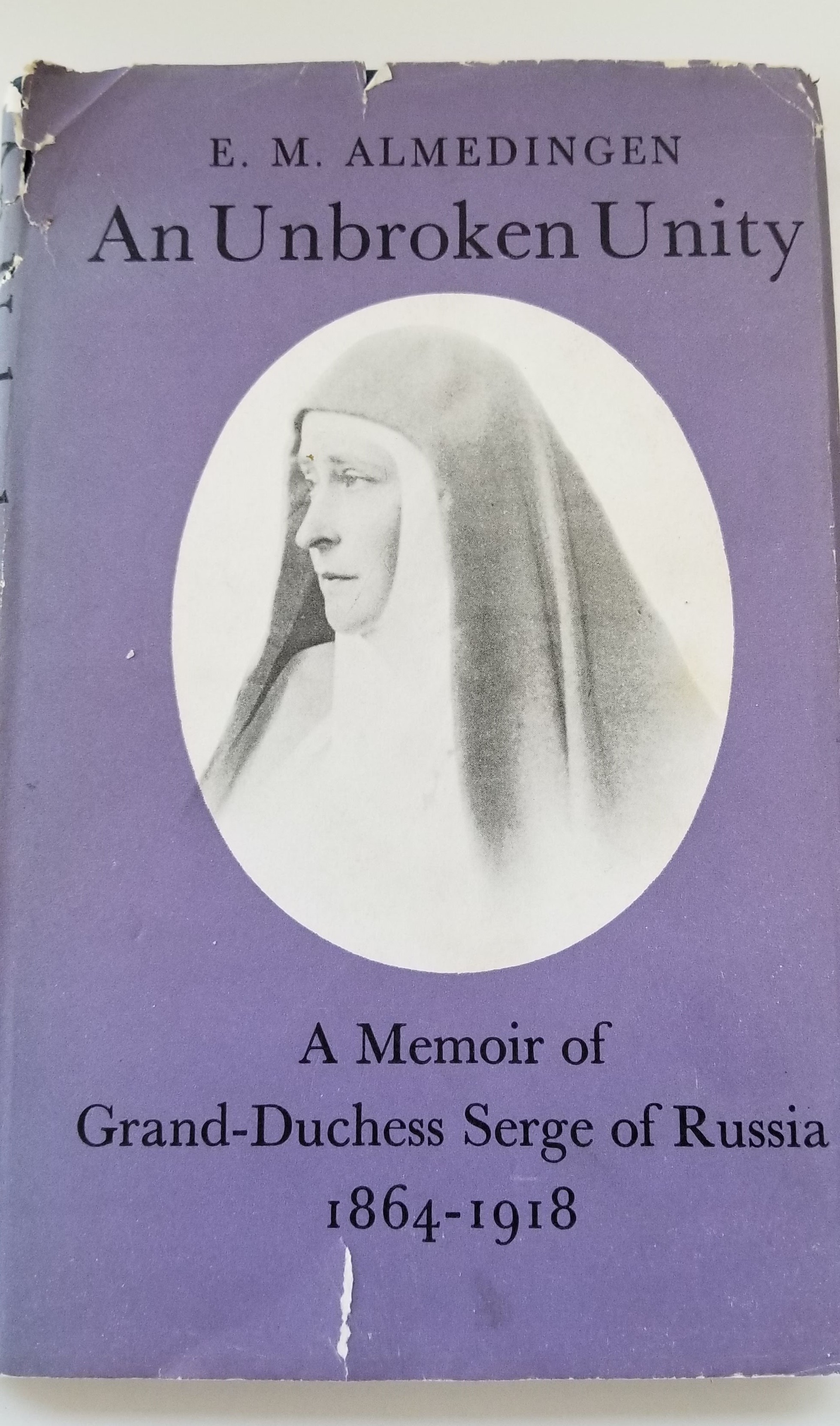
Book Review: “An Unbroken Unity: A Memoir of Grand-Duchess Serge of Russia – 1864-1918” by E.M. Almedingen

Every now and then, it’s possible to find a book that inspires and moves you and this book did that for me. While reading a biography of Princess Alice, mother of HRH Prince Philip, Duke of Edinburgh, the author mentions her aunt, Grand-Duchess Elizabeth as having a profound influence on Alice with her foundation of a convent and nursing and feeding the poor. The author highly recommended Ms. Almedingen’s biography of Elizabeth and I was lucky enough to find a used copy of this book, published in 1964.

There are few books published on the Grand-Duchess. This author, of Russian, English and German heritage, spent some time in Russia before the first World War and had relatives and friends who knew the Grand-Duchess personally. This book is a biography but it’s in the style of a memoir and includes many first hand stories. The life of the Grand-Duchess is filled with happiness, hope and tragedy and these personal stories deepen the narrative.

Elizabeth was a granddaughter of Queen Victoria. Her parents were Princess Alice of the United Kingdom and Louis IV, Grand Duke of Hesse. Her sister was Alexandra, Tsarina of Russia, wife of Tsar Nicholas II. Indeed, Elizabeth was instrumental in her sister marrying the Tsar, something she may have later regretted. Elizabeth married Grand Duke Sergei Alexandrovich of Russia, an uncle of the last Tsar. It was a love match and a successful, though childless marriage, which ended when Serge was tragically assassinated.

Widowhood opened up an opportunity for Elizabeth to create a life of piety and charity. She grew up Lutheran in her home country but once in Russia, she came to love the Russian Orthodox church and converted. After careful consideration, she began wearing a habit and built a convent and community to nurse, feed and teach the poor in Moscow. This was a thriving community and did significant charitable work. It was most unfortunate that the Romanov dynasty’s fall and the rise of communism had a deleterious effect on the community and on the life of Elizabeth.

I’m very impressed with Ms. Almedingen’s writing. She has keen insight into Russian society at the turn of the century as well as in the mind and motives of the Grand-Duchess. Her personal stories are fascinating. This is a mindful, conscientious, and considerate recounting of the Grand-Duchess’ life. Almedingen obviously cares deeply about her subject. She has a couple of other books about the Russian Imperial family that I might need to look into.

Book Review: “Charles II: King of England, Scotland and Ireland” by Ronald Hutton

Hutton Charles II book cover

This biography of the Stuart Restoration King Charles II was recommended by the author of another book I was reading for research.  He said it was the best biography on this king that he had found.  That was enough of an endorsement for me.

Mr. Hutton was a reader in History at the University of Bristol at the time of publication (1989).  This was ten years after Lady Antonia Fraser’s magnificent biography of Charles II was published.  Hutton’s book is completely different from Fraser’s although he gives her great praise for her work.  The difference is, Hutton relies entirely on primary sources to tell the story consisting mostly of letters.

This volume is an in-depth examination of the politics of the reign of Charles II, including Scotland and Wales.  While he covers the life of the king, it explains more about the men who surrounded him and helped him rule his three kingdoms.  If you are looking for personal details, Fraser’s book would be more relevant.  Hutton is looking for who surrounded the king, who gave him advice, and how did Charles make decisions.  The lives of the councilors can sometimes be as fascinating as that of the king.

This is not an easy read.  At times it was a little dry and some of the politics could be confusing.  It helps to have a working knowledge and background on the era.  But I found Hutton’s insight into the personalities of the king, queen, Charles’ mistresses and the men who surrounded him to be very absorbing.

The final chapter supplies the author’s conclusions upon the virtues, vices and achievements of Charles II.  He states he realized early on he was dealing with a legendary figure.  In constructing his view of Charles, he tried to use only what was said about him by his contemporaries and weed out the material that was apocryphal.  Hutton has done a remarkable job.  I now have an improved understanding of this king and his reign.


Book Review: “Richer Than Spices” by Gertrude Z. Thomas

richer than spices book cover


The subtitle of this book is “How a royal bride’s dowry introduced cane, lacquer, cottons, tea, and porcelain to England and so revolutionized taste, manners, craftsmanship, and history in both England and America”.  How’s that for a long subtitle?  The book was published in 1965 by Alfred A. Knopf of New York.

Portugal was a pioneer in active exploration and trade since the fifteenth century when Henry the Navigator supervised and financed many men to find a passage around Africa to the “East Indies”.  This was a rather nebulous term that encompassed all of the area east of the continent of Africa all the way to China and Japan.  Many Portuguese had sailed to these areas and opened and manned factories.  These establishments would barter with the natives for whatever goods they had to offer and trade with them, bringing many new and exotic items to western and northern Europe.

By the seventeenth century, the newly restored Stuart king Charles II was looking for a bride.  Primarily for financial reasons, he settled on marrying Catherine of Braganza, the daughter of King John IV, the newly restored Braganza monarch of Portugal.  Catherine’s dowry was extremely lucrative for England.  It included an enormous cash payment of £300,000 pounds along with the ports of Tangiers and Bombay in India.  England was also given access to trade with other places in the world such as Brazil.

King Charles would eventually turn over Bombay to the commercial enterprise known as the East India Company.  EIC would use Bombay as a base to increase trade from India, China and the East Indies, bringing items such as cane, lacquer, cottons, tea and porcelain to Europe and England.  When Catherine arrived in England, she brought lacquered cabinets from Japan and introduced the drinking of tea for pleasure to the court.

Gertrude Thomas is an expert in antiques and furniture. She explains in this book how the dowry of Catherine of Braganza brought these different items to England and America and enhanced the quality of life for ordinary people.  For the most part, the people of England wore wool or linen from the Low Countries.  With the opening of trade with Bombay, brightly painted and affordable cottons began to arrive, giving people more options for clothing and household items.

Chairs were made of wood but with the introduction of cane, chairs became lighter and more decorative with woven cane used for the seat and backs of chairs.  Catherine’s Japanese lacquered cabinets were a sensation and these started to arrive in England for people to store their goods.  Tea, which had been used primarily for medicinal purposes, now became a drink for pleasure.  It began to be sold in coffee and tea shops and stores.  By the eighteenth century, the drinking of tea was totally ingrained in Britain as part of its culture.

The growth of the drinking of tea led to the increase in trade of porcelain from China.  The beverage needed a pot to hold the extremely hot water for steeping the tea.  The East India Company began importing porcelain and it grew in popularity.  Eventually paintings, vases, candlesticks and other items “Chinoise” became a part of decor and furniture in many households that could afford it.

Not only did this dowry result in an increase in trade of these items in England.  They also found their way to America.  As Thomas says, these items revolutionized taste, manners, craftsmanship and history.  The book is filled with illustrations and is prudently footnoted and includes a bibliography.  Thomas’ delight in her subject shines through and I found this book to be thought-provoking and educational.

Book Review: “Scandalous Liaisons: Charles II and his Court” by R.E. Pritchard

Scandalous Liaisions book cover


There is no doubt, the court of King Charles II of England was decadent.  This book tells the entire story of this hedonistic king, beginning from his youth in England, through his exile in Europe, his restoration to the throne of England and up until his death.  Every mistress is covered here and not just for the king.  Pritchard details the lives of some of the noteworthy men of the era such as Charles’ brother, James, Duke of York, George Villiers, Duke of Buckingham, and John Wilmot, second Earl of Rochester among others.

All of these men had many mistresses.  Some of them are famous such as Barbara Palmer, Lady Castlemaine and Duchess of Cleveland, Louise-Renee Keroualle, Duchess of Portsmouth, Hortense Mancini, the actresses Moll Davis and Nell Gwyn and Charles’ early liaison with Lucy Walter.   The Duke of York took as his mistress Anne Hyde, daughter of the Chancellor Edward Hyde and made her his wife, marrying her in secret.  Duels were fought over some of these women.  The Queen’s Ladies-in-Waiting were fair game as well as the maids and servants.

What’s different about this book is that the author is a specialist in seventeenth century and modern literature.  He points out how many writers, poets, and playwrights chronicled all of these liaisons in their poetry, lyrics and drama.  Many of these are quoted in the book.  It gives us insight into how other ordinary folk viewed the libertines at court as well as the women.  I have to admit, after a while, reading about all these affairs became a little tedious.  But the quoting of contemporary literature makes this book unique and it is worthwhile if the reader is interested in the subject.


Book Review: “The Honourable Company: A History of the English East India Company” by John Keay

honourable company book cover


This book was recommended to me by a history friend who specializes in eighteenth century English history.  I was looking for an all-encompassing history of the East India Company and this book fits the bill.  Keay gives a very detailed history of the earliest incarnation of the East India Company starting in the Tudor era and continuing into the Stuart reign of kings down to its liquidation in the nineteenth century.  Each ship that sets out in the early years is followed around Africa into the Indian Ocean and into Asia.

The stories told are fascinating.  Keay tells us of the brave men who went on these trips, explored the coastlines, set up factories, and bargained with native chieftains and nabobs from Japan to India to China.  Some of these outposts worked well and survived and some of the men were scandalously murdered.  Many succumbed to fever and disease.  There were pirates and private traders.  Cargoes were stolen or sunk or arrived in port in England with no problems.

The inner workings of the company are covered here with the raising of subscriptions initially and then stock being issued later.  Sometimes the profits were outstanding but many times money was lost.  The East India Company at one point was abolished and then reincarnated, causing conflict in the outlying trade posts around the world.  Eventually the company raised its own army to protect the factories.  The Company became a government unto itself, creating its own trading agreements and fighting wars.

The East India Company has a vast and varied history and this book covers it all.  Some of the writing is a little dry but there are plenty of exciting stories to make up for it.  The personalities of the men involved were quite interesting.  I would recommend this book if you are seeking an overall history of this global corporation.

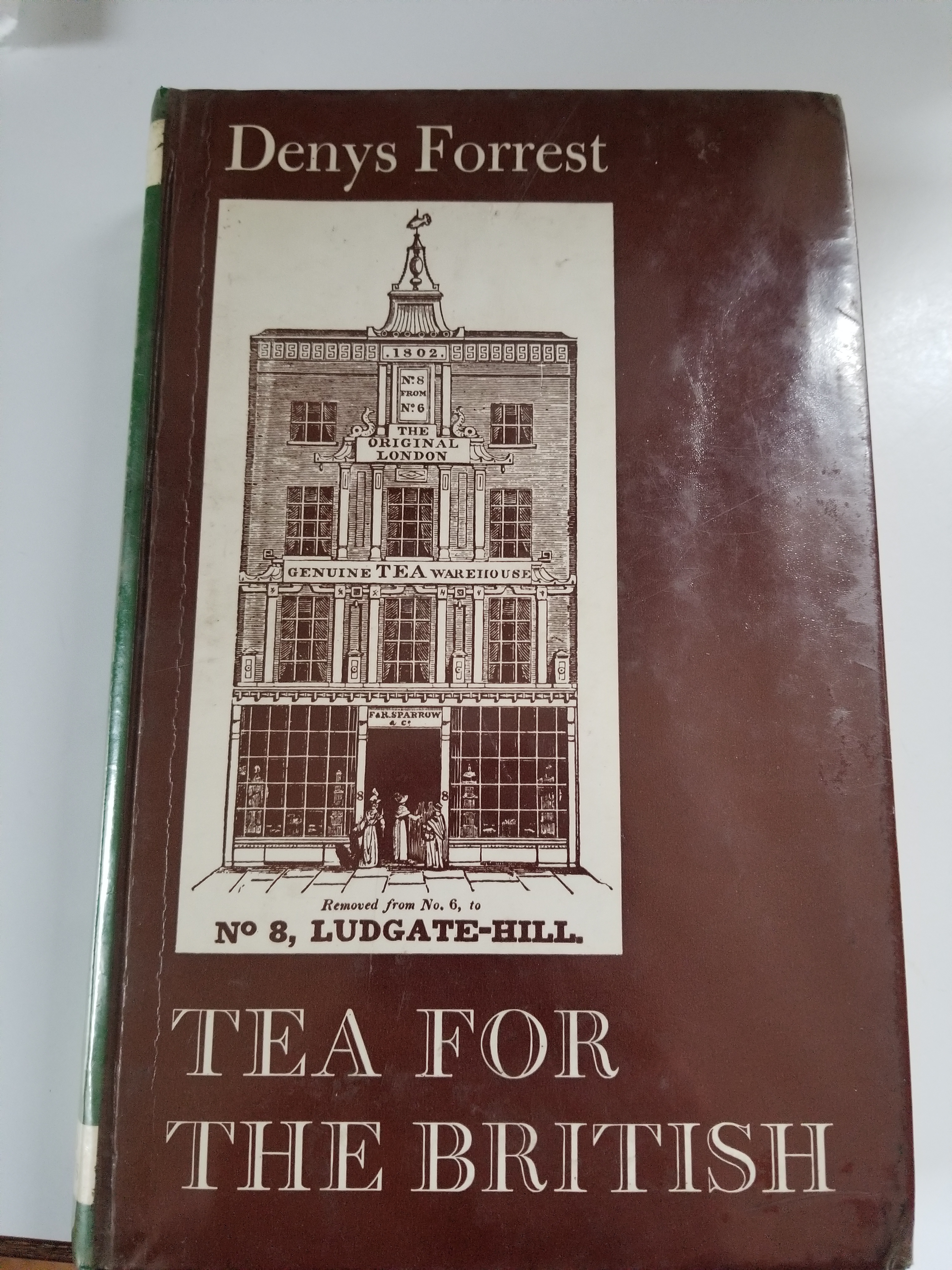
Book Review: “Tea for the British” by Denys Forrest

20181124_145739

The subtitle of this book is “The Social and Economic History of a Famous Trade”.  I had no idea the history of the tea trade in Britain was so fascinating.  The author, Denys Forrest was a writer and journalist before changing careers and working in the tea industry.  Consequently he was uniquely qualified to write this book.

Forrest has researched the papers of the English East India Company and those of various tea companies in Britain.  He begins with recounting how tea first started to arrive in the country.  Early traders found tea in China where it was grown on bushes and then the leaves were harvested and brought to Europe in chests on ships.

At first tea was believed to have had medicinal purposes so it was found in chemist shops.  When Catherine of Braganza came to England to marry King Charles II, she introduced the drinking of tea for non-medicinal purposes at the Stuart court.  The trade grew and the EEC set up a building in Mincing Lane to receive and auction tea shipments.  The tea was sold in coffee shops and then grocers.  Demand became astronomical.  China limited how much trade could be done in their country so enterprising merchants brought the seeds of tea bushes to India and later Ceylon (Sri Lanka) and began growing it there to meet the demand.  Later tea was grown in Africa and even South America.  The EEC lost its monopoly in the nineteenth century and the trade in tea was opened up afterwards.

Forrest explains the different grades of tea leaves and how the tea came to be sold and consumed and innovations in the industry.  The story of how tea came to be put in teabags is really interesting.  There are lots of statistics in this book like how much tea was auctioned for and how much housewives paid for it in shops and stores, and how much tea was consumed per person in Britain.  There are stories about shops in Liverpool, Manchester, Glasgow, Edinburgh and Norwich and histories of different vendors.

Forrest really knows his tea!  And he tells us about it with a really light touch and a keen sense of humor.  This book was published in 1973 and sadly that’s where the story ends.  He laments the invention of iced tea and wonders what will happen to the drinking of tea as the consumption in Britain had declined as the book ended.  I enjoyed this book very much.