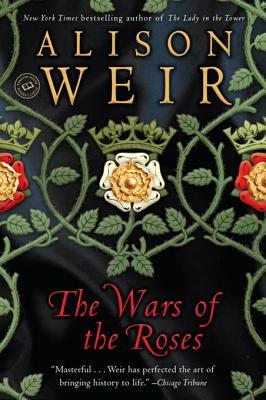
Book Review: “The Wars of the Roses” by Alison Weir

wars-of-the-roses-book-cover

This is a ripping read! It was very hard to put this book down. Weir, in her inimitable way, can really write a good story. As she states in the introduction, Weir is not just recounting the history of the Wars of the Roses. Her intention is to give us her insight into the personalities involved. Indeed, what drove the Wars ever forward was the temperaments and egos of the principal characters.

Weir takes us back in time to the reign of King Richard II and his deposition by his Lancastrian cousin Henry of Bolingbroke who became King Henry IV. Many historians count this as the origin of the Wars of the Roses. Bolingbroke was the son of John of Gaunt, the third son of King Edward III and Philippa of Hainaut. Technically, the heirs of the second son, Lionel of Antwerp would come first according to primogeniture. When King Henry VI’s reign degenerated into corruption and upheaval, Richard Duke of York came to believe he had a stronger claim to the throne as a descendant of Lionel, initiating warfare to assert what he thought was his rightful place. Thus began the series of battles in what came to be known as the Wars of the Roses, the name given to the conflict by the Scottish author Sir Walter Scott in the eighteenth century. What exactly the conflict was called by contemporaries is a matter of debate to this day.

When York dies in battle, the war is continued by his eldest son Edward, the future King Edward IV. Weir is masterful in explaining all the intricacies that led to the various battles. She gives excellent descriptions of the battles, citing primary sources. I especially like how she tells us the status of the battlefields to this day. As always, she writes in chronological order.

Each personality is described with her own personal insight. Richard Neville, 16th Earl of Warwick, who came to be known as the Kingmaker, was very adept at using propaganda for his own ends. King Edward IV was ruthless. Queen Margaret of Anjou was intensely relentless in protecting the rights of her husband and son. William de la Pole, 1st Duke of Suffolk came to a very bad end. Edward IV’s queen, Elizabeth Woodville and her family suffered greatly during the conflicts. The reader should be warned that the narrative concludes with the end of the readeption of Henry VI and the restoration of Edward IV. There are only a few short pages on what happened next.

The only critique I would give this book is that it was written in 1995 and some of the history has gone through revisions since then. For example, Queen Isabeau of France was not a notorious, pleasure-seeking adulteress. Elizabeth Woodville wasn’t greedy and arrogant. But these are just minor points in a magnificent narrative of this complicated and unsavory time in English history. I highly recommend this book.

Book Review: “Elizabeth Woodville: Mother of the Princes in the Tower” by David Baldwin

baldwin-elizabeth-woodville-book-cover2

This is a very concise, no nonsense, sympathetic and non-biased biography of Elizabeth Woodville. She was the wife of King Edward IV of England and mother of the two princes who disappeared from the Tower of London during the Wars of the Roses and also the mother of Elizabeth of York who became Queen of England when she married the victor of the Battle of Bosworth, Henry Tudor. This made her a matriarch of the Tudor dynasty of Kings of England.

I like the way Baldwin breaks down Elizabeth’s life into its various phases. There is little information on her early life but it was interesting to see how Elizabeth was sent to the Grey family to be educated and how she married a son of the family. Elizabeth was widowed after giving birth to two sons and then she met the king. The way Baldwin tells the story, Elizabeth and King Edward barely knew each other and their secret marriage happened very quickly. This really stands out from reading this biography. The marriage appears to have been a spur of the moment decision on Edward’s part and could possibly have been a great surprise to Elizabeth.

The early marriage was going very well but then King Edward was deposed for a short time. Because Elizabeth was English, she had no outside assistance and was forced to take sanctuary in Westminster Abbey with her children while her husband was overseas. While there she gave birth to her first surviving son by the King. This must have been a very anxious time for her.

Edward did regain his throne and there was a period of peace in the kingdom until the King’s unexpected death. Elizabeth had a hard time under the reign of Richard III. It was during this time that her sons disappeared. Eventually, her eldest daughter married Henry Tudor and a new dynasty was founded. Elizabeth was forced into retirement at Bermondsey Abbey and lived in poverty the last five years of her life.

This book explains it all. Baldwin addresses all the historical mysteries of Elizabeth’s life, giving all the theories and angles. There are genealogical tables, a section of pictures, excellent notes to the text and a select bibliography. I would recommend this book for those who don’t know Elizabeth’s life and for scholars.

Book Review: “Richard the Third” by Paul Murray Kendall

kendalls-richard-iii-book-cover

So it was with great trepidation that I started to read Paul Murray Kendall’s biography of Richard the Third. I absolutely loved his Louis XI, the Universal Spider book. But I had a sneaking suspicion Kendall was an apologist for old Richard III. Well, my suspicions were confirmed in the first chapter! About Richard III’s father, Richard Duke of York, Kendall says his “abilities were moderate” and “Excessive greed and ambition…seem to have been largely absent from his character”. Kendall goes on to say “It would require the unrelenting enmity of a queen (Margaret of Anjou) to remind him that he owned a better title to the throne than Henry the Sixth”. I thought, this is going to be good. But I decided to give Kendall a pass because the book was written in 1955 and a lot has changed since then.

Despite my reservations and all of its flaws, this is a fabulous book. Kendall resorts to purple prose but for the most part he relies on primary sources to tell Richard’s story. There are a few places where his bias is obvious. If the reader takes this in stride, Kendall reveals a lot of insight, not only into Richard himself but into life in fifteenth century England. He breaks down the intricate relationships between king and nobles during the conflict that came to be known as the Wars of the Roses.

He covers Richard’s life from birth until his death at the Battle of Bosworth in August 1485. He doesn’t mince any words about some of Richard’s actions as king. He says Richard did consider marrying his niece Elizabeth of York. He also asserts that the evidence supports the theory that the princes in The Tower died on his watch and that he was responsible even though it could not be proven in court. He devotes an entire appendix to examining the evidence about the princes. There is also another appendix where he gives his thoughts on Richard’s character. He feels Richard felt guilty about taking the throne and this colored his actions.

His comments on Richard’s condition of being a hunchback are way off base as we now know. He says the reason one shoulder was higher than the other was due his military training and using a heavy sword. He also states that Richard’s bones were thrown in a river as part of the Dissolution of the Monasteries during the reign of King Henry VIII. We now know this is not true. Kendall is particularly harsh in his comments about Henry VII.

Despite all this, this book is a real page turner. It was hard for me to put it down and I was disappointed when I was finished. The chapter describing the Battle of Bosworth is masterful. I would recommend the reader read all the notes to the text in the back of the book as they are packed full of historical information. This book definitely clarifies the life of Richard III.

Book Review: “Margaret of Anjou: Queen of England” by Philippe Erlanger

erlanger-book-cover

In my research into the queens of England, I’ve been looking for a conventional biography of Margaret of Anjou. A contemporary biography of her doesn’t exist. This one was first published in 1961 in French under the title of “Marguerite D’Anjou et La Guerre Des Deux Roses” (Margaret of Anjou and the War of the Two Roses). This English version was published in 1970 and translated by Edward Hyams. Erlanger was a well-known French biographer who wrote many historical books before passing away in 1987. Just as an aside, he was the originator of the idea of the Cannes Film Festival which began in 1939.

Erlanger says in his introduction: “Nearly five centuries after her death an impartial Frenchman, brought up in his country’s traditions, but who is a friend and admirer of England, has tried, using modern methods, to review the indictment whereby posterity tried Henry VI’s fascinating queen, and ultimately condemned her.” I have to say I enjoyed reading a French writer’s view of English history!

At times this book reads like a novel and at other times like true history. Because this book was written in the 1960’s, he pretty much condemns Margaret as having taken many lovers. This has largely been disproven by now as propaganda from her political enemies. If you can get past this, the narrative is enjoyable. The first part of the book covers Europe in 1430 and then describes Margaret’s upbringing by her grandmother Yolande of Aragon at the court of Anjou. This pretty much sets the stage for Margaret’s extraordinary knowledge of statecraft that should have served her well in England during the chaos of her husband’s reign. However, she was a woman and she was French so her tactics didn’t have too much influence over the warring nobles of her husband’s court.

The author goes into great detail about Margaret’s life and the politics of England. There are some photos in the book and some genealogical tables, a limited bibliography but no index. As mentioned, if you can get past some of the historical flaws and drawbacks in the book, I highly recommend it. It will give the reader a better understanding of the Wars of the Roses and the uncommon life of this queen.

Book Review: “The Medieval and Post-Medieval Image of Eleanor of Aquitaine” by Michael R. Evans

inventing-eleanor-book-cover

Everybody loves Eleanor of Aquitaine. But did you know there are a lot of myths and legends that surround her story? Michael Evans has studied all the evidence from primary sources forward in an effort to find the real story of this popular Queen.

Evans begins by saying the actual evidence of Eleanor’s life is scarce and a lot of it is written by chroniclers hostile to her politically. He also argues that she is not any more extraordinary than any other medieval woman of her time based on the historical evidence. He then recounts the two categories of stories about her: the Black Legend and the Golden Myth.

The Black Legend myths include how she killed the fair Rosamund Clifford, mistress of King Henry II and the stories of her alleged incest with her uncle Raymond of Toulouse. He tells how the legend of the murder of Rosamund first appeared and then grew hugely out of proportion. The evidence of the incest is negligible but it was common practice to blacken a powerful woman’s name with tales of sexual misconduct.

The Golden Myth includes the stories of Eleanor dressing as an Amazon to go on Crusade and how she and her daughter Marie presided over scenes of courtly love in Poitou. Both of these myths were debunked a long time ago but he shows how they got started and continued to have life in books and literature. (For more on the legends surrounding Eleanor’s life, click here.)

There is quite a bit in the book about how Eleanor has appeared in literature, fiction and non-fiction, on stage, in the movies and on television. Katherine Hepburn in “The Lion in Winter” is especially commended in her portrayal of Eleanor. Anyone who is interested in Eleanor will not be disappointed in this book. It sheds an eye-opening light on her story. It is my opinion that Eleanor’s life was remarkable even without the legends.

Book Review: “Lucy Walter: Wife or Mistress” by Lord George Scott

lucy_walter

I was looking into the life of the woman who was the mistress of King Charles II before he became king with the Restoration of the Monarchy in England in 1660. Her name was Lucy Walter and in the Oxford Dictionary of National Biography entry on her written by Robin Clifton, this book is listed as one of the sources for the article. I knew there was no contemporary biography of her so I thought I would check it out. I happened to find a cheap used copy of the book on the internet.

It turns out that Lord George Scott is a descendant of Lucy Walter’s family and this book was published in 1947. Scott passed way in February of that year, before the proofs of the book came back from the printer. The task of reading the proofs and readying the book for publishing was taken up by Scott’s son and an assistant. The author’s intention in writing this book is to prove that Lucy Walter was in fact married to Charles.

Lucy became Charles’ mistress early on during his exile after the execution of his father King Charles I. She gave birth to a son, James Crofts, later called James Scott in April of 1649. Charles at all times acknowledged James was his natural, illegitimate son. Charles also insisted he never married Lucy Walter. He never faltered in this assertion and swore to it in front of his councilors twice. There is no existing written evidence that he married Lucy.

Scott uses this book to present many arguments that Lucy was married. He insists she came from a good family and would not have turned into a fallen woman. He cites many sources. He especially mentions the letters from Charles’ sister the Princess of Orange who refers to Lucy as Charles’ wife. He talks about witnesses to the marriage itself. He says Lucy had paperwork showing her marriage was legal and she turned this over to John Cosin, later bishop of Durham when she was on her deathbed. The papers were supposedly kept in a black box which later disappeared.

The book has some wonderful illustrations and a family tree for Lucy. It also gives some good biographical information on her life. But Scott’s convoluted arguments are presented in a jumbled order. Characters come and go in the story and it’s all very confusing. In the end, I’m afraid he is not very convincing. All of his contentions just don’t add up. In looking at other evidence, there is no doubt Lucy was a woman of loose morals and caused a lot of trouble for Charles. He son James also didn’t come to a good end during the reign of his uncle King James II. While the basic premise of the story is of interest, Scott does not succeed in his mission of clearing Lucy’s name.

Book Review: “Tales of the Marriage Bed from Medieval France (1300-1500) by R.C. Famiglietti

couple-in-bed-in-illuminated-manuscript

This book was listed as a reference which I found while researching Isabeau of Bavaria, Queen of King Charles VI of France. I happened to find a used copy of the book although it wasn’t cheap. There is an interesting section on her in which he describes her as the “perfect wife”. I decided to read the whole book.

Published in 1992, this is one of the best books I’ve read recently. I love French history. What makes this book unique is it delves into the lives of the people of France, from royalty down to ordinary people. It’s more of a social history. Most of the stories related deal with the nobility including the petty nobility. As it states on the book cover, “The vignettes, episodes in the lives of married couples, allow us to observe the vast panorama of life in medieval France and to explore the mores, attitudes, and concerns of the time.”

Sections of the book deal with the following topics: incest, choosing a mate, negotiating a marriage, weddings, elopements and abductions, mistresses and bastards, adultery, abuse, murdering a mate, the perfect husband and the perfect wife. Some of these tales are gruesome. In some of these instances, there were court cases brought to justice. This gives Famiglietti a chance to describe the workings of the justice system in medieval France. These stories definitely give us a glimpse of the status of women during this time period and it certainly isn’t pretty.

I especially liked the description of a wedding in Bordeaux in 1460. One episode relates a ghastly tale of a wife being murdered by her husband. There’s a long drawn out case of incest in the fourteenth century. There’s a description of a marriage where the husband beat his wife and one where the wife was kept locked up in a tower. All of these are true tales which Famiglietti found in historical sources.

This book has a map of medieval France, an extensive bibliography, sixty-eight black and white plates depicting some of the characters in the stories along with extensive explanations for the illustrations. This book is well researched, well written and fascinating to read. Famiglietti also wrote a book about royal intrigue during the reign of King Charles VI. I’m looking for a copy of that one for a reasonable price.

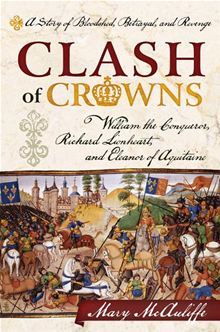
Book Review: “Clash of Crowns” by Mary McAuliffe

clash-of-crowns-book-cover

Found this book while browsing at the local bookstore. It looked pretty interesting. The subtitle is “William the Conqueror, Richard Lionheart, and Eleanor of Aquitaine” and at the top of the cover it says “A Story of Bloodshed, Betrayal, and Revenge”. Sounds great doesn’t it?

Well, it is. McAuliffe obviously has a great passion for this era of French and English history. The book was inspired by the great fortification Château-Gaillard in France which was built by Richard the Lionheart during his clashes and wars with Philip Augustus II, King of France. She uses this castle to tell the story of Richard, beginning with the Viking Rollo, the first count of Normandy. The story progresses down to Rollo’s descendant William the Conqueror who became King of England in 1066.

William’s grand-daughter, Empress Matilda should have been Queen of England when her father King Henry I of England died. But her cousin Stephen got to England first causing the period of strife called the Anarchy while Matilda and Stephen fought for the throne. Eventually, Matilda’s first born son by Geoffrey of Anjou became King Henry II. Henry married Eleanor of Aquitaine and had several sons who rebelled against their father.

All of this is recounted in this book in the context of European medieval history. McAuliffe brings all of these historical characters to life with all their admirable qualities and their foibles. She gives a detailed description of the fighting between Lionheart and Philip Augustus. Lionheart built the magnificent and modern fortress of Château-Galliard to safeguard a crucial point of defense in an effort to maintain possession of the duchy of Normandy. The castle was called Richard’s “Proud Daughter”. The final attack and siege of the castle by Philip is described in detail. It makes for fascinating reading.

Anyone who loves English and French medieval history will enjoy this book. It is well organized, and researched and well written. It includes a bibliography, illustrations, maps, a chronology and a list of key people in the story. Even if you know the history it’s a fun read and if you don’t, it’s a great introduction.

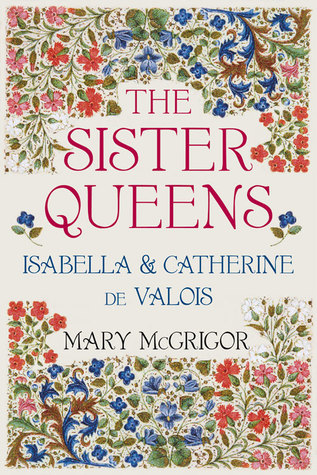
Book Review: “The Sister Queens: Isabella & Catherine de Valois” by Mary McGrigor

sister-queens-book-cover

There is very little existing historical information on Isabella and Catherine de Valois. Both were the daughters of King Charles VI and Queen Isabeau of France and both women were Queens of England. This book reflects this sparsity of information.

If you are expecting lots of detail of the lives of these two women, you will be sorely disappointed. However, if you are looking for compelling medieval French and English history, this book fits the bill. McGrigor puts these women into their context and fills in the blanks with good storytelling about the early lives of Isabella and Catherine. Isabella’s husband Richard II lost control of his government and was forced to abdicate the throne to his cousin Henry IV. It took some time but Isabella was finally allowed to return to France and was married to her cousin Charles of Orleans who was much younger than Isabella. This may have turned out to be a successful marriage according to McGrigor. Isabella had a daughter Jane and then died shortly after giving birth. McGrigor continues the story of Jane in this book.

Catherine was the youngest daughter of Charles and Isabeau. Her story is woven within the context of the Hundred Years War and the aggression of King Henry V of England who she eventually married. McGrigor gives us a good accounting of the life of Catherine in England and also of the politics in France during the reign of Catherine’s son Henry VI who was King of France as well as King of England. These details give the reader a good understanding into what led up to the Wars of the Roses in England.

However, I do have a few issues with this book. McGrigor is perpetuating the myth of the bad reputation of Isabeau of Bavaria of being a bad mother, having many lovers and being dissolute. This has all been debunked by several historians. The other issue that is a problem is the many grammatical and typographical errors in this book. I would venture to guess about a third of the dates are transposed and incorrect. For example, a date which should read 1422 reads 1522 or 1322. The History Press is doing a disservice by either not hiring editors to correct these errors or if they do hire editors, they do a terrible job. These issues aside, I would recommend this book for those who are interested in English and French medieval history.

Book Review: “Margaret of Anjou: Queenship and Power in Late Medieval England” by Helen E. Maurer

Margaret of Anjou Maurer book cover

In the course of my research on English queens, I searched for a biography of Margaret of Anjou, the wife of King Henry VI. There appears to be no contemporary biography of her which in itself is interesting but I did find this book. It’s not a recounting of her life in a biographical sense however but a thought provoking examination of Queenship and power in medieval England.

The author says she was introduced to Margaret of Anjou by seeing a performance of a Shakespearean play in Central Park in New York City. Later, while studying in school for a doctorate, she found an article where an historian called for an examination of Margaret’s role in the political upheaval in England now known as the Wars of the Roses. She ended up writing this book.

This is not an easy read as it is definitely an academic exercise. She describes the role of a medieval queen in many different spheres such as motherhood, intervention and mediation, and aiding her retainers. A medieval queen, especially one of foreign origin, could never rule directly. Any influence she had would be through her husband the king.

Maurer tells us about Margaret’s upbringing which in many ways was extraordinary. She was highly educated and due to the influence of her formidable grandmother Yolande of Aragon, learned statecraft. Her marriage to King Henry VI came with great expectations of peace between England and France after the devastation of the Hundred Years War. When Margaret came to England as a teenager, her entrance into was celebrated with hopeful allegory. Maurer gives us a long description of these celebrations.

It was only after Margaret bore a son that she started to come into her own. At the same time of her pregnancy, her husband succumbed to madness throwing the government of the realm into chaos. Margaret did what she could to preserve the power of her husband and secure the interests of him, herself and her son, working within the boundaries of a medieval queen. Despite her best efforts, there was infighting and backstabbing among the nobility who were doing the best they could to preserve their own self interests.

In the end, Margaret became the figurehead of the House of Lancaster and even led her own troops. This was not really within the realm of the powers of a medieval queen as Maurer argues here. For better or worse, Margaret did the best she could and ended up losing everything. She just couldn’t overcome the restrictions placed on her as a medieval queen.

Maurer makes some very cogent and logical arguments here. She has some insight into the men Margaret was up against in her fight to preserve the power and prestige of her family. As stated, if you are looking for a conventional biography, this book isn’t it. But I would still recommend it if you have an interest in medieval royal women’s position, function and responsibility in history.