Book Review: “Henry VII” by S.B. Chrimes

Henry VII Chrimes book cover

As historians, we are lucky to have a selection of biographies on English kings published by the Yale University Press called “The English Monarchs Series”. For over thirty years, the biographies, written by eminently qualified historians, have given us the latest research on these important figures in history. S.B. Chrimes, born in 1907, was head of the department of history at University College, Cardiff, the University of Wales, from 1953 to 1974. This biography of Henry Tudor was first published in Britain in 1972 by a British publisher. A paperback edition was issued in 1977 and Yale University Press published their edition in 1999 with a new forward by George Bernard, reader in Tudor history at the University of Southampton.

Bernard’s forward essentially updates the research done by Chrimes since the original publishing of the work in 1972. For the most part he states the work is still valid with a few revisions based on new research. The earliest works on Henry were from James Gairdner and Wilhelm Busch from the 1890’s so Henry was definitely due for a fresher look. Chrimes is quick to point out the biography of Henry VII’s life from Sir Francis Bacon (1561-1626) should be taken with a grain of salt and refutes several of Bacon’s arguments.

Part one of this book gives us an overview of Henry’s life up to the Battle of Bosworth in August of 1485. This is followed by a chapter on his accession, coronation, marriage and family. Next he covers the issue of security which Henry dealt with for the rest of his reign. Chrimes recounts the uprisings and pretenders who haunted Henry for many years. This section of the book is very interesting.

The rest of the book gives us many details on Henry’s reign based on meticulous research by Chrimes and others. Part two of the book is entitled “The Personnel and Machinery of Government” with sections on the King Council, Seals and Secretariats, Financial Administration, Parliaments and Great Councils and Judicature. While this section is very informative, some may find the material dry and uninteresting. If you are a Tudor historian, you will learn a lot about the workings of early Tudor government.

Part three is entitled “Statecraft”. This section deals with law-making, law enforcement, fiscal and financial policy, economic and social policy, relations with the church, Henry’s policies toward Wales and Ireland and his handling of foreign policies. Again, some of this information may appear dry but I found the chapters on Wales and Ireland and Henry’s foreign policy to be very appealing. It was especially interesting to read about how Henry made overtures to find a wife after his queen, Elizabeth of York died in 1503 and how this impacted his foreign policy. For most of his reign he lobbied for a diplomatic and trade alliance with the Holy Roman Emperor and sought to marry Margaret of Austria, Duchess of Savoy and Regent of the Netherlands. Ultimately, Margaret refused to marry him.

Chrimes addresses the viewpoints that Henry was rapacious and miserly. He basically argues yes and no to both. One item of interest is he refutes Francis Bacon’s statement that when Henry died he left a fortune of two million pounds. He says this isn’t true and that most of what remained in the treasury was precious items and jewels, Henry’s favorite investments. There is a diverse selection of appendixes in the book and a myriad of great photos. There is a valuable bibliography and a nice selection of family trees as well. This book is an excellent and reliable overview of King Henry VII’s life and reign and I highly recommend it to lovers of Tudor history.

Book Review: “Isabella: The Warrior Queen” by Kirstin Downey

Isabella the Warrior Queen book cover

I’ve been spending a lot of time in Spain recently! There were two biographies of Isabella of Castile on my book shelf and I’ve now completed reading both of them. My interest in Isabella is a result of my lifelong love of Tudor history and the fact that Isabella was the mother of Catherine of Aragon. I tackled Peggy Liss’ biography first which was very interesting. Downey’s book is also a worthy read.

Downey explains in her afterword that she has a lifelong fascination in the life of Isabella. When she was a young girl living in the American-controlled Panama Canal Zone, she was captivated by the ruins of Spanish buildings which have existed since the voyages of Christopher Columbus. Panama was a trade hub for the shipping of the treasures from the New World to Spain and beyond.

While Liss’ biography is an academic work with exceptional detail, Downey has a different, but still relevant approach to Isabella’s life. She writes about the life events of the Queen, sometimes giving a keen insight into her life and at other times giving an overall picture. There is a little more detail in Downey’s book about Christopher Columbus and his voyages and their impact on Spain as well as the entire world.

Downey covers some new material here as well. She describes the cannibalism the Europeans discovered in the Caribbean and tells us about the possible origin of the sexually transmitted disease of syphilis coming from the New World. She also believes, based on her own journalistic work, that there was a history of sexual abuse in Isabella’s family.

There is some good information about Isabella’s children, especially Prince Juan and her daughter Juana. I particularly enjoyed the details of the life of Juana. Personally, I go back and forth on whether Juana was actually mentally ill or a victim of the men around her. Downey makes the case that Juana was perfectly sane but was unprepared and untrained in how to rule. Juana just wasn’t up to the task. There are some great descriptions about how Juana’s husband, the Archduke Philip, basically abused Juana as well as accounts of how her father plotted to take the throne of Castile from her. This is some really intriguing information and I may have to look into the biographies of Juana listed in the bibliography.

Isabella was an accomplished administrator and a warrior. There are many things to admire about her. But there is also a dark side to her personality. Even taking into account the mindset of medieval and Renaissance Spain, Isabella’s personality is full of religious fervor and rigidity. This leads to some objectionable events during her reign such as the mistreatment and exile of Jews and Muslims as well as the evils of the Spanish Inquisition. Downey argues the Inquisition was mostly the brainchild of Isabella’s husband Ferdinand and he used it for his own purposes for political gains and to increase his personal wealth.

I don’t want to get into a comparison between Downey’s and Liss’ work as both books have their own merits. I will say that Downey’s work is an easier and more enjoyable read and I highly recommend it. Reading both books gives a complete historical rendering of the life of this extraordinary Queen.

Book Review: “Arbella Stuart: A Biography” by Blanche C. Hardy

arbella hardy book cover

I’m just going to admit it up front. I really enjoy reading history written by historians of another era. This biography of Arbella Stuart, a grand-daughter of Margaret Tudor, was written in 1913! As the author duly notes in her “Biographical Note”, the story of Arbella has been told many times beginning from right after her death in ballads and poems to biographical notes, novels and memoirs in the eighteenth and nineteenth centuries. Arbella is mentioned by Agnes Strickland in “Lives of the Tudor and Stuart Princesses” and some of Arbella’s letters were published in 1866.

That being said, I believe Blanche C. Hardy gives us the whole story of Arbella’s life in riveting detail and in her own words by quoting her letters, many of which still exist in various archives. She begins with the illicit conspiracy between two mothers, Bess of Hardwick and Margaret Douglas, Countess of Lennox who plotted to marry their children, Elizabeth Cavendish and Charles Stuart, 1st Earl of Lennox. Bess of Hardwick was a formidable noblewoman during most of the monarchies of the Tudor era. Margaret was the daughter of Margaret Tudor by her second husband Archibald Douglas, 6th Earl of Angus. Margaret and her sons Henry and Charles could rightly claim the throne of England. So the conspiracy to marry her son Charles without telling Queen Elizabeth I could have dire consequences. Bess and Margaret secretly plotted the marriage and managed to carry it off.

Elizabeth Cavendish gave birth to Arbella in 1575. Both of Arbella’s parents died while she was an infant and she was brought up in close confinement by her grandmother Bess of Hardwick. Bess, at the very least, wanted to restore Arbella’s interest in the Lennox estates which were taken away when her parents died. At the most, she harbored an interest in putting her grand-daughter on the throne of England. Arbella was given a first class education and there were many who were interested in marrying her to men in the aristocracy of England and Europe. She was therefore kept under strict guard most of her life. There is no evidence Arbella was ever deeply involved in any of these plots which to some extent was extraordinary.

However, Arbella did conspire to make a marriage to the nobleman William Seymour, a descendant of Mary Tudor, sister of King Henry VIII through her grand-daughter Katherine Grey, sister of Lady Jane Grey, the Nine Days Queen. Any alliance and heir born of this combination would have a considerable claim to the throne of England. Needless to say, this proposed alliance created a huge controversy. Queen Elizabeth was furious at the prospect and Bess of Hardwick broke off her relationship with Arbella for the rest of her life. This incident was the first indication that Arbella did not really have a stable mind. Letters written during this time strongly indicate this.

Once Queen Elizabeth died, Arbella was in high favor with Elizabeth’s successor, King James I. She had a high position at court and was well liked by James and his Queen and their children. But she managed to throw this all away by marrying Seymour in a secret ceremony and against the wishes of the King. She never regained her position at court and in fact, made a daring attempt to flee from England with Seymour. Hardy’s description of Arbella’s escape and Seymour’s breakout from the Tower of London makes for some exciting reading. Arbella’s only flaw was that she was too close to the throne of England. This made for an unfortunate and miserable life for her and her story doesn’t have a happy ending. Hardy does a great job of recounting all the foibles and adventures of this eccentric woman. We are lucky that Nabu Press has reprinted this one hundred year old volume so we can enjoy it. I highly recommend this book.

Book Review: “Bess of Hardwick ~Empire Builder” by Mary S. Lovell

Bess of Hardwick cover

The Freelance History Writer is scheduled to go to the United Kingdom later this year on a tour following in the footsteps of Mary Queen of Scots. Needless to say, I am thrilled! So, in preparation, I’m trying to do some reading by some of the authors who will lecture on the tour and about some of the personalities related to Mary Queen of Scots. Mary was held captive by Queen Elizabeth I in England for nearly twenty years. For the first fifteen years, her jailer was George Talbot, 6th Earl of Shrewsbury and his formidable wife, Elizabeth Shrewsbury, otherwise known as Bess of Hardwick. One of our lecturers on the tour will be Mary S. Lovell who has written this biography of Bess.

This volume has been on my to-read shelf for quite some time so I was happy to give it a look. What a huge and very pleasant surprise. As Lovell tells us in the introduction, Bess is best known as the builder of some great houses in England such as Hardwick Hall and Chatsworth which we will visit. Bess and her children are the founders of the Dukedoms of Devonshire, Portland and Newcastle as well as the barony of Waterpark. Lovell is not the first biographer of Bess but she feels Bess hasn’t been presented properly by these prior authors. Previously she has been interpreted as being a shrew and as having a stormy relationship with Queen Elizabeth. Lovell spent many years pouring over volumes of letters, financial accounts and manuscripts by and about Bess and found no evidence for these portrayals. What she found was a strong, intelligent and entrepreneurial woman who got along well with Queen Elizabeth. In fact, she was a valued friend of the Queen.

Bess was married four times and had numerous children and step-children. Lovell gives us not just the details of Bess’ life but a full accounting of the lives, marriages and careers of her four husbands. This really enhances the biography as all the men are quite interesting. There are many twists and turns to this story, especially within all the family dynamics and dysfunctions. One of Bess’ husbands may have even been killed with poison by one of his brothers. Lovell tells us about Bess’ adroitness at handling her housekeeping duties, how she fed her family and servants, how much money she spent, how she entertained noble guests, her building projects and how she furnished her homes.

The years of the captivity of Mary Queen of Scots in the Shrewsbury household really bring to light the personality of Mary. I love the descriptions of how Bess and Mary sat together and labored at their embroidery. There are tapestries in Bess’ great homes still in existence that were worked on by Mary herself which I hope to see on the tour. Mary comes across as a conspirator who used her infamous charms and various methods to try to escape her jailer, even working to split up the marriage of Bess and her husband George. While this isn’t the only reason for their break up, Mary’s connivance certainly didn’t help the marriage.

This book isn’t just a biography of Bess and her husbands and family. It’s full of great details on the social history of the Tudor era. Born during the reign of King Henry VIII, the many changes in the monarchy during her eighty-one years affected her and her family in so many different ways. I especially enjoyed the insights into the operations of the reign of Queen Elizabeth I and her ministers. Lovell explains how Bess and her husbands negotiated their service at court with the management of their estates. Bess, through marriage and adept handling of her finances became a wealthy woman in her own right. This book is an easy and intriguing read and I highly recommend it.

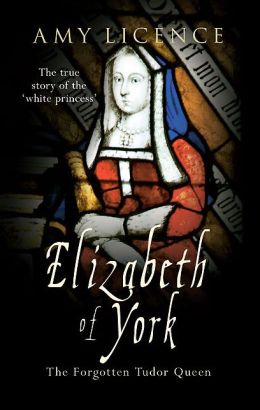
Book Review: Elizabeth of York: The Forgotten Tudor Queen by Amy License

Elizabeth of York book cover

Because of the TV show “The Tudors” which aired recently, there had been an increased interest in this fascinating dynasty of English kings. Consequently, there has been an upsurge in the number of books written on the dynasty itself, as well as the many historical figures from the era. While it has been common knowledge among historians that there is very little detailed information on the life of Elizabeth of York, mother of King Henry VIII, this hasn’t stopped a couple of authors from writing biographies of her.

Alison Weir recently released her biography “Elizabeth of York: A Tudor Queen and Her World” and Amy License also penned a work on her life. License is prolific and popular writer of books, articles and blog posts about women’s and children’s issues in Tudor and medieval England. She also has appeared on television and radio in England talking about these topics.

Elizabeth of York: The Forgotten Tudor Queen unfortunately has very little information about Elizabeth herself. However, License’s style is unique in that she views her subjects from a family and feminist perspective. There is a lot of information and detail about how women lived during this era. There is some good information on Elizabeth’s mother Elizabeth Wydeville. I learned Elizabeth of York enjoyed a very close knit family, seeing her parents often and having very loving relationships with her siblings. License also has good explanations for the politics of the War of the Roses and how Elizabeth’s husband Henry Tudor dealt with the myriad of pretenders to his throne.

So while there is not as much detailed information about Elizabeth in License’s book as there is in Weir’s, it is still a worthwhile read because of License’s distinctive feminist point of view and there are also some great pictures in the book. I would recommend this book to anyone interested in Tudor women.

Book Review: Margaret Beaufort: Mother of the Tudor Dynasty by Elizabeth Norton

Margaret Beaufort book cover

I had heard all the usual things about Margaret Beaufort. She was married very young, had a child and was never able to conceive again, connived and conspired to put her son Henry on the throne of England and she was the mother-in-law from hell. I had no idea if any of this was true or not and wanted to learn more. When I heard Elizabeth Norton had written a biography of Margaret, I ordered my copy and settled down to read it.

Norton’s writing style is very linear and chronological. It really made reading the book flow. And to my surprise, I found Margaret to be a very sympathetic character. Her early childhood was marred by the apparent suicide of her father but she was sincerely close to her mother and her step-sisters and brothers. She received a more than adequate education, unusual at the time for a woman. Margaret’s value as an heiress and good match was recognized early. Margaret was contracted to marry at the age of nine but this marriage was never consummated and was eventually annulled.

Margaret was associated with the House of Lancaster but managed to negotiate the landmine that was the War of the Roses very adeptly. King Henry VI gave Margaret to his half-brother Edmund Tudor in marriage and it was with him she had her son Henry to whom she devoted her entire life. When Edmund died young, Margaret was astute enough to find another husband and protector. She was forced to marry again when her third husband died after suffering wounds in battle. During all the ups and downs of the different kings on the throne between Lancaster and York, Margaret was flexible and agreeable and managed to carry on with her comfortable life until Richard III took the throne.

Margaret was certainly guilty of conspiring to elevate her son to the throne. At one point she was attainted by the government, lost all her wealth and land holdings and suffered house arrest. But her fourth husband Thomas, Lord Stanley, allowed her to continue to communicate with her son who was in France. Eventually Henry Tudor was successful in bringing forces to England and winning the Battle of Bosworth in 1485. Margaret was now able to live her life as a free and independent woman and greatly enjoyed a high position at court. She was also a generous supporter of charity and university education.

And perhaps she wasn’t the mother-in-law from hell after all. The evidence from this book and from other biographies of Margaret’s daughter-in-law, Elizabeth of York all suggest the women probably got along quite well. That’s not to say they didn’t disagree on occasion. But there appears to have been some family unity. Norton has certainly done her research and her writing style makes this an informative and pleasant read. Norton also includes a transcription of all the surviving letters written by Margaret herself. I enjoyed the book very much and came to admire Margaret Beaufort as the formidable survivor that she was.

Review: “Elizabeth of York: A Tudor Queen and Her World” by Alison Weir

Portrait of Elizabeth of York

Portrait of Elizabeth of York

When I heard that Alison Weir was writing a biography of Elizabeth of York, I eagerly awaited its release. Having been a long time reader of Weir’s non-fiction works and knowing very little about Elizabeth of York made this book highly anticipated. And I was not disappointed!

Elizabeth of York has very much been an enigma to historians. While we still don’t know what her personality was really like, this book shines a bright spotlight on her. It starts out by explaining the circumstances into which Elizabeth was born as the eldest child of King Edward IV. The War of the Roses had been ongoing for about ten years at the time of her birth. Weir tells us of the family dynamics and how the throne of England vacillated back and forth between the members of the Houses of Lancaster and York. When Elizabeth was fairly young, her father was forced to flee the country and Elizabeth, her mother and her sisters sought refuge in sanctuary. Edward eventually came back and had a fairly peaceful reign until his unexpected death in 1483.

Elizabeth and her family’s life was thrown into turmoil as her uncle, Richard, Duke of Gloucester, declared her and her brothers and sisters illegitimate. He set aside Elizabeth’s brother King Edward V and took the throne as king. Her mother took her family into sanctuary once again and both of Elizabeth’s brothers disappeared in the Tower of London, making Elizabeth her father’s heir. It was a very tense time. The plotting and scheming on the part of King Richard III, Elizabeth and her mother and Margaret Beaufort and her son Henry Tudor is explained in great detail by Weir.

Once Henry Tudor won the Battle of Bosworth in August of 1485 and gained the throne of England by right of conquest, he married Elizabeth. Weir explains that Henry wanted to make it clear he had won the throne and wasn’t relying so much on Elizabeth’s position as her father’s heir to legitimize his conquest. Perhaps this is why we don’t know as much about Elizabeth as we would like. Whether it was at her husband’s bequest or her own wish or both to remain in the background, we will never know.

Weir gives us a detailed account of Elizabeth’s life as queen, almost on a day-to-day basis. She tells us how Elizabeth spent her time and her money, who gave her gifts, the birth of her children and the status of her health. She has some great insights into Elizabeth’s relationship with her husband and her children. I found this to be quite fascinating. The book gives us great insight into life in the early Tudor court. It is meticulously researched and highly footnoted and has a very long list of sources. Weir has obviously done her research and is at the height of her writing powers. A thoroughly enjoyable read!