Book Review: “John the Fearless” by Richard Vaughan

This book is the second in the series of four by Richard Vaughan on the Valois Dukes of Burgundy. The subtitle for this volume is “The Growth of Burgundian Power”. In the first book about John’s father Philip the Bold, Vaughan recounts how the Valois gained ownership of the duchy and county of Burgundy as well as other properties and the formation of the Burgundian state. This book details how John the Fearless enlarged that state.

John the Fearless is the most fascinating of the Burgundian dukes for me so far. It was during his tenure as duke that much of what is now the Low Countries came under Burgundian control. John was also a major player in the conflicts of the kingdom of France under the mad King Charles VI. John believed he had the right to act as regent during the king’s illnesses and he wasn’t about to let anyone stand in his way. He even went so far as to have the king’s brother Louis, Duke of Orleans murdered in the streets of Paris at night in 1407. This was considered a most shocking act. Most importantly, he never was forced to officially pay for the crime.

John’s reign as duke is filled with warfare, treachery, murder, mayhem, mistresses and illegitimate children. John gained his soubriquet “the Fearless” after a murderous battle he won over the rebellious subjects of the city of Liège on the field of Othée in what is now Belgium. In a chapter entitled “The Means to Power”, Vaughan goes into meticulous detail about the finances, the civil service and the Burgundian army. Some may find this dry material but I found it to be intriguing. There is even a chapter on how John’s wife Margaret of Bavaria ruled Burgundy on his behalf while he engaged in empire building elsewhere.

The last chapter concerns the assassination of John the Fearless on the bridge of Montereau in 1419. This came about due to John’s active interference in the government of France. He made many enemies due to his calculated murder of the Duke of Orleans. And the Dauphin Charles (the future King Charles VII) sided with the Duke’s enemies, the Armagnacs from the French civil war. Vaughan states there are many versions of the assassination on the bridge that create much confusion. But he has scrutinized all the sources and come up with common themes and consistencies to figure out the true course of events. For him, there is no doubt the murder was meticulously planned and the Dauphin, whether he delivered any real blows or not, was responsible for the outcome.

I find there is nothing better than French medieval history. This book is easy to read and jam-packed with detail and absorbing stories about an eccentric if not deranged personality. Moving on to read about John the Fearless’ son Philip the Good.

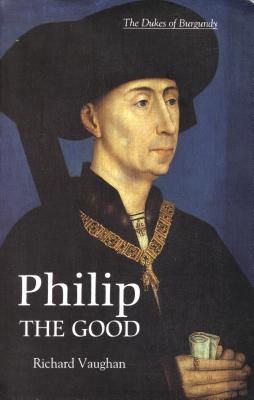
Book Review: “Philip the Bold” by Richard Vaughan

It really was not my intention to read the four volume series on the Dukes of Burgundy by Richard Vaughan. However, I was looking at the first volume on Philip the Bold for some research on an article and found it to be quite interesting. It seemed worthwhile so I started reading it. The subtitle for this one is “The Formation of the Burgundian State”.

Richard Vaughan did extensive research on the four Valois Dukes of Burgundy in the late fifties and the four volumes were published in the early sixties. They were republished in paperback in 1979 and again in 2002 with reprints three more times since then. They are readily available from any bookseller and some will even give a discount for buying all four. There are copious sources for the history of this time period as the Burgundian dukes and the Flemish state kept meticulous records, many of which still exist. It is obvious Vaughan methodically pored over these primary sources and studied secondary sources as well.

Vaughan clearly states in his introduction this is not meant to be a standard biography of Philip the Bold. He was more interested in describing Philip’s policies, his administration, his court and his finances and to depict Burgundy as a European power. Vaughan begins with the backstory of how the original Duke of Burgundy’s dynasty died out and how King John the Good of France, for all intents and purposes, gave the duchy and county of Burgundy to his younger son Philip. This is the beginning of the Burgundian state as defined by Vaughan. Philip used different methods and processes to increase his power and territories. These include marriage alliances, expansion, diplomacy and inheritance.

The author addresses how Philip added Flanders and other counties and cities to his territories, how he administered them and his finances. There are many charts and spreadsheets in the book about the finances of the duke. Some may find this tough going and dry material but I actually found it fascinating. Vaughan argues Philip couldn’t have expanded his territories without the help of the French crown and these tables illustrate that vividly. The book includes several maps exemplifying Philip’s holdings and an extensive bibliography.

Vaughan’s writing is fast-flowing and easy to read. Even though it is not a conventional biography, it is possible for the reader to clearly grasp the personality of the duke. The book is a pleasure to read and I learned a lot. Looking forward to volume two, John the Fearless.

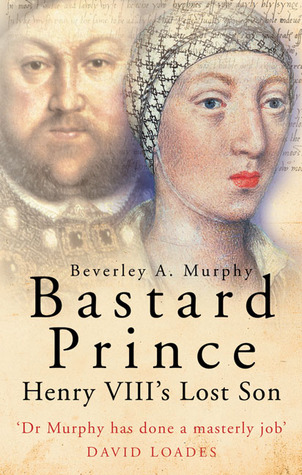
Book Review: “Bastard Prince: Henry VIII’s Lost Son” by Beverley A. Murphy

I was doing some research for an article on Henry Fitzroy, illegitimate son of King Henry VIII and happened to find this book. I was pleasantly surprised as I had no idea someone had written a biography of Fitzroy. The book was first published in 2001 and I was lucky enough to find a used copy.

Beverley Murphy apparently wrote her dissertation on Fitzroy and felt his life deserved further investigation. She was encouraged by the historian David Loades to write the book. I like the format of the book. She begins with the life of Fitzroy’s mother Bessie Blount. While this recognized mistress of Henry VIII has been a shadowy figure, Murphy fills in the gaps with the known information on her life. The next chapter discusses how King Henry may have considered making Fitzroy his heir. Indeed this is a theme throughout the book. Murphy covers the pros and cons of the argument, giving insight into how King Henry may have viewed this possibility.

King Henry elevated Fitzroy to the dual titles of Duke of Richmond and Somerset and he was therefore known primarily as the Duke of Richmond. The years Richmond spent in the north of England at Sheriff Hutton and Pontefract are covered in detail here. There are plenty of primary sources giving Murphy great insight, especially regarding his finances. Richmond was given a huge patrimony of land, castles and income, making him the premier noble in England. Part of his duties included being the titular head of a reconstituted Council of the North, the position held by Richard, Duke of Gloucester (the future King Richard III) under his brother King Edward IV.

Another position given to Richmond was Lord Lieutenant of Ireland. The duties of this position were covered by a council and Richmond never visited Ireland. Murphy makes the case that Henry VIII considered elevating Richmond to King of Ireland, possibly in an effort to make him more sought-after on the marriage market. There were some efforts to marry him to a continental princess. Murphy has a whole chapter on the role of the council in Ireland under Richmond and how the council was used a political tool by King Henry and Thomas Cromwell.

As Richmond approached his adulthood, he was beginning to assert himself. He was more in charge of his holdings and was given a role in representing the king such as acting as a witness to the execution of the Carthusian monks of the London Charterhouse and the execution of Queen Anne Boleyn and in entertaining dignitaries at court. There were plans for him to move into Baynard Castle in London and to begin conjugal relations with his wife Mary Howard. But all this was for naught as Richmond died. He was only ill for a short time and most likely died of the same medical issue as his half-brother King Edward VI.

This book is thorough, well written and an enjoyable read. Murphy covers Richmond’s legacy and has a discussion on how he nearly became King Henry IX. There are genealogical tables, a section of pictures and a comprehensive bibliography. I’m willing to venture this is the definitive biography of Richmond and I highly recommend it.

Book Review: “Four Princes” by John Julius Norwich

The subtitle of this book is “Henry VIII, Francis I, Charles V, Suleiman the Magnificent and the Obsessions that Forged Modern Europe”. Whew! How about that for raising expectations? But I have to say, this book delivers.

There is a blurb inside the front cover that says this: “Never before had the world seen four such giants coexisting. Sometimes friends, more often enemies, always rivals, these four men together held Europe in the hollow of their hands.” This pretty much sums up the era and what a time it was. Europe was experiencing great upheaval. There was monumental transformations in matters of religion. The Renaissance began with new discoveries in science, mass printing of books and gorgeous art being produced.

Amidst all this upheaval, there were four princes who ruled Europe, all with monumental egos. This books introduces us to the four men, giving their backgrounds. The author explains their changing alliances along with their bellicose warfare. There were many different meetings between these men which are described here. Treaties were made and broken. Invasions were mounted. Suleiman the Magnificent was at the outskirts of Vienna but drew back twice. Francis I of France stunned Europe by forging ties with the Sultan in an effort to stave off having France taken over by Charles V. Because the author has written about the papacy, he includes a lot of papal history and how it relates to the other rulers. You just can’t make this stuff up.

I would classify this book as ‘popular history’, whatever that means. It is not meant to be an academic work and indeed, I found a few historical mistakes. These are just a few of the most glaring errors. Norwich states that King Francis I’s mother Louise of Savoy attended peace talks in Toledo in July of 1525. This is incorrect. Francis’ sister Marguerite was present and spoke directly to Charles V about the release of Francis from captivity after the devastating French loss at Pavia.

Norwich also states that Cardinal Compeggio had been sent to England in 1518 and that he remained there from that date until the legatine court at Blackfriars in 1529 was convened to discuss the divorce of Henry VIII from Catherine of Aragon. This is not so. Compeggio had to travel from the continent to England for this trial. Norwich also has a footnote regarding Sir Thomas More where he states that Henry had More arrested after he refused to attend the King’s wedding to Anne Boleyn. I have no idea where he got this and it’s almost laughable.

But this does not detract from the overall joy of reading the fascinating history of early modern Europe. The book has a section of beautiful color photos and a limited bibliography. It’s a good starting point for those who are new to the era and a good vacation read for those who know the history.

Book Review: “Stephen and Matilda: The Civil War 1139-1153” by Jim Bradbury

The story of the Empress Matilda is fascinating on so many levels. While I knew the basic outline of the civil strife in twelfth century England called the “Anarchy”, I didn’t know many details. I happened to find an affordable used copy of this book and it turned out to be worth every penny.

There is no doubt Bradbury knows the history. He quotes many sources in the narrative. The first two chapters are “The Causes of the Civil War” and “The Two Sides”. He gives thorough background on the family of King Henry I, the death of William Adelin and how Henry compelled the nobles, clergy and magnates to swear an oath to support Matilda as his heir. Bradbury believes, based on the chronicles, that Henry may have groomed Matilda to be a Queen Mother rather than a Queen Regnant and changed his mind on his deathbed, supporting his nephew Stephen as his successor. The author explains which nobles in England and Normandy fought for each side, describing a great cast of characters.

Once the lines were drawn in the sand, the nobles chose sides between the anointed King Stephen and his opponent Matilda. Matilda eventually arrived in England to press her case and the war starts. The Angevins, as Matilda’s party were called, managed to take control of some of the country. The height of Matilda’s success was the First Battle of Lincoln in February, 1141 which Bradbury recounts in great detail. After this, Matilda’s behavior and temper caused her to lose support and Stephen was released and ruled again.

Bradbury explains how both parties avoided all-out pitched battles throughout the whole conflict. There really were only two standout battles with noteworthy causalities. The rest of the fighting consisted of sieges and counter-sieges with the building of castles and counter-castles. No one managed to achieve a definitive victory because the nobles were adept at changing sides whenever it was to their advantage. Bradbury calls the era of the fight with the Empress the Matildine war and the era with her son Henry the Henrician war. Eventually, the nobles recognized Henry as Stephen’s heir and peace prevailed. The author also gives some background information on Matilda’s husband Geoffrey, Count of Anjou and his conquest of Normandy. It was interesting to learn how he wrested this duchy from King Stephen.

I especially liked the last chapter where Bradbury gives the historical arguments for whether this conflict should be christened the “Anarchy”. He ends with the effects of the civil war. There is a good bibliography listed. I have to say I now have a thorough understanding of this conflict and more insight into twelfth century England and how the Plantagenets came to power. I highly recommend this book.

Book Review: “Game of Queens” by Sarah Gristwood

It isn’t very often you come across a book that is nearly perfect in execution but this one fits the bill. Gristwood had done her homework in researching the history of these women, creating a most enjoyable read. The subtitle of the book is “The Women Who Made Sixteenth-Century Europe”. Her premise is the game of chess and she relates a myriad of women to the game and how it played out in the politics of the sixteenth Europe.

There were several women who emerged to rule in Europe during this period, either as regents, queen consorts or outright queen regnant. Many of readers favorite women are portrayed here: Katherine of Aragon, Anne Boleyn, Margaret Tudor, Mary Queen of Scots, Margaret of Austria, Queen Mary I and Elizabeth I of England, Louise of Savoy, Anne of Brittany, Queen Claude of France, Catherine de Medici, Marguerite of Valois, Queen of Navarre and her daughter Jeanne d’Albret, Margaret of Parma, Mary of Hungary and my personal favorite, Anne de Beaujeu. Many of the women are interconnected. Anne de Beaujeu schooled Margaret of Austria and Louise of Savoy in politics and government. She wrote a book for her own daughter, Suzanne de Bourbon called “Lessons for My Daughter” that Gristwood quotes from liberally and which carries a lot of good advice for all of these women. Anne Boleyn served at the court of Margaret of Austria. Gristwood recounts how all of these stories are interrelated.

While I am familiar with most of these women’s stories, there were a few that were new to me. I really enjoyed Gristwood’s take on Margaret Tudor, Queen of Scots. She has some great insight into Margaret’s personality. Some new territory for me were the stories of Mary of Hungary and Margaret of Parma who succeeded Margaret of Austria as Regent of the Netherlands for the Holy Roman Emperor Charles V. These women had a very difficult task, especially after the enormous social upheaval created by the Reformation. The story of Jeanne d’Albret, daughter of Marguerite, Queen of Navarre is most intriguing with the twists and turns of her marriages and her feisty defense of Protestantism.

By quoting letters and chronicles, Gristwood gives us a glimpse of all these women’s personalities allowing them to come to life. In addition to being beautifully written, this book has some nice accompaniments. There are genealogical tables, a list of dramatis personae, a section of lovely color photos and a chronology of events. Gristwood gives a nicely chosen bibliography for more in-depth reading. I cannot recommend this book enough. This is Sarah’s best work yet.

Book Review: “Royal Intrigue: Crisis at the Court of Charles VI 1392-1420” by R.C. Famiglietti

Ever since I finished reading “Tales of the Marriage Bed from Medieval France (1300-1500)” by R. C. Famiglietti, I’ve been searching for a copy of “Royal Intrigue”. I wasn’t having any luck as no library near me had a copy and the rare copies I could find for sale were ridiculously expensive. With persistence, I kept checking various used book outlets and as luck would have it, I found an affordable used copy of this book.

Famiglietti’s approach to history and his writing style are very hard to resist. And the subject of the mental health of King Charles VI France intrigues me greatly. It stands to reason any insight into the illness of Charles VI would have a bearing on that of his grandson, King Henry VI of England who suffered a similar disorder. As I opened the book, it became clear I had hit the jackpot. The first chapter is titled “The Mental Disorder of Charles VI”.

While it is impossible for anyone to diagnose a subject that lived over six hundred years ago, Famiglietti gives a very convincing argument. He first recounts the historical records from the chroniclers who describe Charles VI’s behavior to come up with a list of symptoms. He then consults with the Diagnostic and Statistical Manual of Mental Disorders to see what illness matches these symptoms. His theory is some form of schizophrenia because he exhibited three out of the five defining factors for this illness. Within the diagnosis of schizophrenia, there are several different types. Charles exhibited symptoms that overlapped with these different types but Famiglietti recognizes an underlying theme: persecutory delusions.

After doing this detective work in psychiatry, Famiglietti gets to work writing about the different factions at the French court and how they schemed and plotted to take power while the king was incapacitated and how his persecutory delusions dictated the king’s reactions to these different schemes and events. Here we meet the major characters: Louis of Orléans and his son Charles, Duc d’Orléans, Queen Isabeau of Bavaria, the Dauphin Louis, Duc de Guyenne, the king’s eldest son, King Henry V of England and John the Fearless, Duke of Burgundy to name only the most important.

The opening salvo is the first psychotic episode Charles suffered in the summer of 1392 when he went berserk and killed four or five people. While he never had another attack this severe, for the rest of his life he moved in and out of calm and manic bouts, all the while suffering from the persecutory delusions. Famiglietti knows his sources and is able to reconstruct the history day by day if not down to the hour. He can tell when the king was having a good and bad day with his illness. He mentions letters which were issued either only in the king’s name or with the king and the council or letters written by other parties in the fight. He sometimes tells us where the principal character ate dinner and when they left to travel elsewhere in the kingdom. He has such wonderful insight into the personalities of the main players and even corrects other historian’s work where he thinks they have been mistaken in their conclusions.

All of this is pretty fascinating stuff! He covers the murder of Louis of Orléans and the assassination of John the Fearless. He explains the circumstances that led to the Treaty of Troyes in 1420. Other than the first chapter on the mental illness of the king, the best chapter is the one in which he describes the Cabochien Uprising of 1413. The royal family must have been scared out of their wits when John the Fearless goaded the butchers and other merchants to revolt. They entered the actual palaces and even took prisoner some of the Dauphin’s servants and had them executed. The Dauphin would work against the Burgundians and the Armagnacs from that point forward until his untimely death shortly afterward.

I loved this book just as much as the “Tales of the Marriage Bed”. In doing some research into R.C. Famiglietti, I was unable to find out any information on the man himself. He was a professor at the City University of New York when he wrote these books in the 1980’s but I have no idea where is now. He is a very unique and innovative historian as well as a great writer. I plan on digging to see if he wrote any other books or articles and try to read more.

Book Review: “Margaret Pole: The Countess in the Tower” by Susan Higginbotham

This is a recent biography of Margaret Pole, Countess of Salisbury, published in 2016. It is very short at 148 pages as well as being very sparse on information on Margaret. There is a great deal of material on the court of King Henry VIII in the book as it relates to Margaret. One thing I enjoyed in reading this is Higginbotham quotes several letters and chroniclers, giving a realistic picture of the times.

The book has a nice section of color illustrations and a respectable bibliography. The appendix section gives a selection of evidence in the Exeter Conspiracy which contributed to the downfall of the Countess. Higginbotham is an engaging writer and exhibits a subtle sense of humor. She cites the work of Hazel Pierce quite a bit. For an agreeable introduction to the life of Margaret Pole, I would recommend this book. For a more detailed and academic rendering of her life, I would suggest Hazel Pierce’s biography.

Book Review: “Margaret Pole, Countess of Salisbury 1473-1541” by Hazel Pierce

The subtitle of this book is “Loyalty, Lineage and Leadership”. I knew very little about Margaret Pole other than she died for her faith and suffered a horrendous execution. First published in 2003, this appears to be the definitive biography of her. The origins of this book lie in Pierce’s thesis which she completed in 1997. Pierce is a trained historian who taught at Bangor University in Wales and she has written extensively on fifteenth and sixteenth British history and on the Pole family in particular.

This book is storytelling and historical research at its best. Pierce has meticulously studied the primary sources to piece together the story of Margaret and her family. Little is known of Margaret’s early life. There is more information about her marriage and then a good deal of data on her life after her husband’s death. What I like about this narrative is the thoughtful insight into the life of her subject. Pierce gives information on Margaret’s status at court and her connections there. She gives a list of her properties and there is a map showing their location. She tells us who her connections were, who her servants were, how she administered her properties and how she arranged marriages for her children.

There are two chapters dedicated to an assessment of the conspiracy that caused the fall of the Pole family. Here is where Pierce is at her best. She unravels the details of the Exeter conspiracy directly from the primary sources and then recounts the consequences. This is the tale of a woman whose children caused her arrest and death. Pierce pulls no punches here. She praises her subject but she is also honest in saying when Margaret and her children made mistakes. Margaret’s son Cardinal Reginald Pole does not come off in a good light here. It was very easy for him to exercise his right to criticize the king when he was in Rome. He either didn’t realize the consequences to his family or he didn’t care.

This book exposed some myths for me. There is very little evidence Margaret supported the church as other medieval noblewomen did. Her only response to the religious changes in England at the time was to not allow her servants to have the Bible in English. Her one fault as far as King Henry VIII was concerned was her loyal support of his daughter the Lady Mary.

The other mythical episode in Margaret’s life concerns her execution. Here, Pierce gives the accounts from the primary sources and explains that orders for her beheading were rushed. The execution took place in a small corner within the confines of the Tower and was not witnessed by many people. Due to unrest in the north of England, the professional executioner had been sent there and so Margaret’s executioner was inexperienced and made a mess of it. She did not refuse to put her head down on the block or run around the scaffolding but died with dignity. I highly recommend this book not just for the information on Margaret Pole’s life but also for the excellent historical research that went into the writing.

Book Review: “Crown of Blood” by Nicola Tallis

The subtitle of this book is “The Deadly Inheritance of Lady Jane Grey”. There are several biographies available on the life of Lady Jane Grey. This is a new one by historian Nicola Tallis published in December 2016.

I have to give Ms. Tallis a lot of credit. This is a well-written, well-footnoted and obviously well researched look at the life of Lady Jane Grey. Tallis gives us a great deal of detailed background on Jane’s family. I especially liked the description of Jane’s father, Henry Grey, Duke of Suffolk. He has a well-deserved, disreputable reputation and Tallis explains why.

Tallis also has examined the reputation of Jane’s mother Frances Brandon. She believes the status of Frances’ character has suffered because of one comment by Jane in an interview. I believe Nicola is right. It is easy to lay 21st century values on the past which is what has happened here with Frances. If we examine Frances’ manner in dealing with the ever-changing politics of the Tudor era, she appears to have survived where the rest of her family didn’t. This is greatly to her credit.

As for Jane, Tallis describes her family life, her education and her correspondence with learned Protestants on the continent, her marriage and her elevation to the throne of England and her downfall in spectacular detail. It is almost as if you are there with Jane. Tallis uses direct quotations from primary sources to tell Jane’s sad story.

There is a section of wonderful color illustrations in the book with portraits of the main players. There are genealogical tables for the house of Tudor, Grey and Suffolk and a timeline of Jane’s life. The appendixes cover the lack of portraits of Jane, a transcript of her debate with Dr. John Feckenham shortly before her death and a list of places to visit to follow in Jane’s footsteps. Tallis has written a very comprehensive bibliography which is a valuable resource for Tudor historians. I cannot recommend this book enough. It was hard to put it down.