Book Review: “Yolande of Aragon (1381-1442) Family and Power” by Zita Eva Rohr

The subtitle of this book is “The Reverse of the Tapestry”. Rohr is using the image of the reverse side of a tapestry to describe the life of Yolande. There were many threads woven by Yolande in her diplomacy during the complicated Hundred Years War.

Yolande is an amazing woman. Born in what is now Spain, she grew up in the cultured and educated court of her parents. Several marriages were discussed for her but she was eventually wed to Louis II, Duke of Anjou and titular King of Naples. This brought her into the sphere of the Valois kings of France and the infighting of the nobles during the Hundred Years War. Yolande was a competent and able administrator and adept negotiator. Although there is no documented evidence, historians are pretty certain she was instrumental in introducing Joan of Arc to Charles VII, thereby creating a turning point in Charles’ fortunes. Yolande’s motivation throughout all of her life was the advancement of her family.

Rohr’s book is not a conventional biography. In fact, this is an academic work and is aimed mostly at history faculty and graduate students. I found the writing to be pedantic and for the most part off-topic. The order of the information provided is scattered. It wasn’t until the third chapter (the book is only 199 pages long) that we start to get a glimpse of Yolande as a woman and politician. This is the point where the book gets interesting. Perhaps it is due to the lack of sources that we don’t know that much about Yolande.

I would not recommend this book to a casual reader. It is expensive and not an enjoyable read. However, for an historian, Rohr has done her research and lays out what she found in the sources giving us what little is known about Yolande and her interpretation of her life. A conventional biography on this pivotal personality in Angevin and French history has yet to be written.

Book Review: “The Maid and the Queen: The Secret History of Joan of Arc” by Nancy Goldstone

I have a great deal of respect for Nancy Goldstone as an historian and as a writer. I’ve read of couple of her books and really enjoyed them. This one is no exception.

Goldstone posits her theory that Yolande of Aragon, Queen of Sicily and Duchess of Anjou is responsible for introducing Joan of Arc to King Charles VII during the Hundred Years War. Most historians accept this theory even though there is no written documentation to confirm it. Goldstone tells how the story of Joan of Arc relates to the myth of Melusine, a female figure of European folklore. The story was created for political purposes for the Duke of Berry, uncle of King Charles VI of France to justify his appropriation of certain French castles.

This book tells the basic story of Yolande of Aragon and her political career and the fascinating life of Joan of Arc. Yolande is such a captivating character. She is strong, intelligent, politically savvy and perfectly capable of carrying out all of her intrigues and plans. Yolande’s motivation first and foremost is her family. She marries her daughter Marie to the Dauphin Charles, thereby eventually making her Queen of France. Goldstone gives us all the juicy details.

Although Yolande’s story is interesting, the story of Joan of Arc is enthralling. Goldstone tells us of her upbringing in Domrémy and how this shaped her mission. She tells us all the details of how she tried to gain an audience with Charles VII and of her dangerous journey through Anglo-Burgundian territory to meet him. Joan is given all she needs to fight and she is instrumental in chasing the English from the siege of Orléans thereby saving France from being overrun by the English. Joan was in the fight in armor and wielded her sword.

After some political maneuvering, Joan goes out on her own and is captured by the Duke of Burgundy who sells her to the English. With the help of a French bishop, the English put her through a sham trial and have her executed. All of this is recounted by the author. Nearly thirty years later, there is a reconciliation and Joan’s sentence is overturned by the French. This is history at its best. Goldstone is a master storyteller. I highly recommend this book. Now I must read the other’s on my shelf that are written by her.

Book Review: “Warfare in Medieval Brabant 1356-1406” by Sergio Boffa

After reading Richard Vaughan’s four part series on the Valois Dukes of Burgundy, my interest in the history of the Low Countries was piqued. The medieval duchy of Brabant, along with Flanders, Holland, Hainault and Artois were all coveted by Philip the Bold, Duke of Burgundy in the mid-to late fourteenth century. Brabant was one of the most powerful of these principalities in the Low Countries and was subject to internal and external turmoil.

Boffa begins this book with a chapter on all the many conflicts experienced by Brabant during this time. John III, Duke of Brabant had no male heir and died leaving three daughters. He named the eldest, Joan as his successor and she married Wenceslas of Luxembourg. Joan would rule Brabant as duchess for almost fifty years, even after the death of her husband. A war of succession broke out after the death of John III. Louis of Male, Count of Flanders was married to Joan’s sister Margaret and thought he had a claim to the duchy. In addition, Brabant was engaged in some attacks on the Duchy of Guelders and other surrounding principalities attacked Brabant. It was a series of long drawn out conflicts. In the end, through alliances, Brabant was drawn into the Hundred Years War and finally succumbed to being annexed into the Burgundian Empire.

After these chapters of overview, Boffa tells us more details about medieval warfare in this era. He covers the place of warfare in the history of Brabant, the causes of war, the different phases of the war and the strategy and tactics. Next he recounts the powers that were engaged in the warfare such as the Duke and the Duchess and their entourage, the household and the Ducal Council. The combatants during the war included the nobility and chivalry of Brabant, the urban militias, mercenaries, the artillery and the specialists.

The most interesting chapters explain the organization of the armies, the revenues of the Duke, the declaration of war and mobilization, the movements of the troops, the means of transport, encampment and lodgings, provisioning, how orders were transmitted and the structure of the army. This is the most interesting part of the book. I found a notable anecdote here. Boffa explains that in the Low Countries, oats were fed to the horses. In the armies of England, the soldiers ate oats! The end of the book has an explanation of the size of the Brabançon army and military obligations and contracts in the Middle Ages. This is most definitely an academic and specialized book but anyone interested in the subject of medieval warfare will find it has substantial details about how armies worked.

Book Review: “The Princely Court: Medieval Courts and Culture in North-West Europe 1270-1380” by Malcolm Vale

This is a very informative academic work that considers the historical evidence of court life in the time period listed. Vale looks at the courts of England, Flanders, Brabant, Artois, Hainault and Holland. Interestingly, the first chapter considers the definition of “court” which historians are still discussing to this day. Vale explains there is no definitive definition.

Items discussed in the book include: Organization and structure of medieval princely households, consumption and expenditure, economics and accountancy, transport and logistics, residences and lodgings, court life and culture including courtly pursuits, ritual and ceremony. And finally, court art and style and court patronage. There is an explanation of livery and how the prince delivered clothing or cloth at certain times of the year to servants of the household and the different types of material they were made of. The household was also provided with food, a place to sleep, wood for fires and candles, etc.

Medieval households were rarely static and they traveled between castles and manors and sometimes stayed in inns or monasteries. I enjoyed the discussion on princely court pursuits. Vale talks about how important gambling was at court and playing games of skill and chance. The most popular games were chess, dice and tables. Hunting and the cult of the chase was a leading pursuit. This involved the keeping of horses, hounds and falcons. In addition to providing entertainment, hunting supplied the court with food.

This book has many black and white illustrations to demonstrate the author’s points. The book provides a large collection of charts and tables translated from the primary sources on many different topics and also several appendices. This is a detailed study of court life for anyone interested in the topic.


Book Review: “Charles the Bold” by Richard Vaughan

The final volume of Richard Vaughan’s four part series on the Valois Dukes of Burgundy does not disappoint! I have found Charles the Bold to be a fascinating historical personality for many years. Initially I read the biography of him by Ruth Putnam which was written in the early twentieth century. She relied on and quoted only primary sources and it is a really good read. Vaughan’s book is certainly more technical and doesn’t have as much of the personal information on the Duke that Putnam has.

Vaughan mostly concentrates on Charles’ pursuit of warfare and suppression of rebellions which define his rule as Duke of Burgundy. There is a good deal of reference to the hatred between Charles and King Louis XI of France, the subject of quite a bit of interpretation and discussion by historians. I really liked this aspect of the book. He also gives some detail on Charles’ marriages, his personality and his court.

Most interesting of all is the discussion of Charles’ many campaigns and warfare. Vaughan explains where he recruited his troops, how he gathered supplies, how he organized the campaigns and how he had weapons manufactured and delivered. Vaughan describes Charles’ talent and supreme ability to create and publish ordinances and organize troops. However, this didn’t translate into victories on the battlefield for him.

By far the best part of this book is the last few chapters where Vaughan recounts the conflict that arose in what is now Switzerland that resulted in Charles transporting his army there to fight. The descriptions of the last three battles he fought at Grandson, Murten and Nancy are gripping reading and spellbinding history. One has to wonder what motivated Charles to keep on fighting against overwhelming odds. He met his gruesome end at Nancy. They found his frozen body the day after the battle. For all intents and purposes, this was the end of the dynasty of the Valois Dukes of Burgundy.

I didn’t want this series to end. These books have to be Richard Vaughan’s magnum opus. They are true masterpieces and I highly recommend all four of these books.

Book Review: “Isabel of Burgundy” by Aline Taylor

The subtitle of this book is “The Duchess Who Played Politics in the Age of Joan of Arc, 1397-1471”. I have to confess, I read this book a few years ago while doing some research. Recently, in reading the four volume series of books on the Valois Dukes of Burgundy by Richard Vaughan, I completed the one on Philip the Good and felt like I needed to revisit the life of Isabel in the context of her husband’s life and decided to re-read it.

It is unfortunate there is no definitive biography of Isabel and this book is not meant to be an academic recounting of Isabel’s life. It is a combination of historical fact with a bit of fiction. This is really unfortunate as the author has an academic background and is the former editor of three academic journals and could obviously have done better. Despite the unorthodox style, I found the book enjoyable because Taylor highlights the personal side of Isabel’s life.

Isabel is somewhat exceptional for a medieval woman of royalty. She was the daughter of King John I of Portugal, the first king of the House of Aviz. Her mother was Philippa, the eldest daughter of John of Gaunt, Duke of Lancaster, and son of King Edward III of England. Although there were many possible marriages discussed for her, she didn’t marry until she was in her early thirties. She would be the third wife of Philip the Good, Duke of Burgundy. Philip married her for her royal birth, ties to England and Portugal and for her ability to have children.

Isabel fulfilled her childbearing duty and would have three sons, of which only one, Charles, survived. However, Philip got a lot more than he bargained for with Isabel. She was highly intelligent. Her parents had educated her along with her numerous brothers and she was especially adept at accounting and negotiating and arbitration. These excellent skills were put to good use by Philip. He allowed her to negotiate peace and trade treaties for the duration of their marriage. Isabel’s English and Portuguese background would influence her efforts at mediation and facilitate good relations between Burgundy, England and France. Her greatest accomplishment may have been the triumphant marriage of her son Charles with the sister of King Edward IV of England, Margaret of York.

Taylor’s narrative in this book emphasizes Isabel’s accomplishments. There are many twists and turns to this era in Burgundian history, the most significant being the fact that Isabel’s husband sent her on many missions while working behind her back to make alliances and war with France. It’s hard to imagine what kind of tension this brought to Isabel’s marriage but it certainly makes an appealing story. The book is not written in chronological order. There are some footnotes which appear at the end of each chapter but there is no bibliography which is disappointing. Although this is an interesting read, a well written and researched biography remains to be written about this fascinating medieval princess.

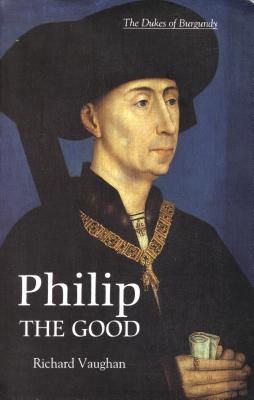
Book Review: “Philip the Good” by Richard Vaughan

Once again, Vaughan delivers with this biography of Philip the Good, third volume of the four volumes series on the Valois Dukes of Burgundy. The subtitle of this book is “The Apogee of Burgundy”. It was during Philip’s reign that Burgundy was at its highest point as a powerful European state and he ruled the longest of any of the Dukes of Burgundy.

Philip was Duke during the end of the struggles between England and France, known as the Hundred Years War. Burgundy played an integral part, sometimes on the side of England, sometimes on the side of France. While these three entities fought and made peace among themselves, Philip was conquering and annexing various part of Northern Europe. Philip fought with Jacqueline of Hainault for several years and finally broke her resolve. She named Philip as her successor and when she died in 1436, he was ruler of Holland, Zeeland and Hainault. He managed to annex Luxembourg into his territories also.

Philip would have to contend with several rebellions in some of his principal cities. He dealt with artisan rebels in Liège and Ghent along with others. King Charles VII of France was a real thorn in Philip’s side. Even though Charles was guilty of murdering Philip’s father John the Fearless, and despite Charles’ many attempts to frustrate and even annex parts of Philip’s empire, the Duke was deferential. He thought of himself as the premier nobleman in France and took his chivalric duties to heart. In fact, Charles VII and his son Louis XI were dead set on taking Burgundy into the royal domain and this would actually come to fruition in 1477.

This book is packed with great information. Vaughan recounts some of the many marriage alliances Philip made with his immediate family and with his nieces and nephews. There is chapter on the Duke and his court which explains how Philip loved pomp and circumstance and would great pageants and spectacles and massive jousting tournaments. He started the chivalric Order of the Golden Fleece and collected medieval manuscripts. Philip was married three times with his final wife, Isabel of Portugal being his best and most helpful wife. She would act in his name many times and was instrumental in negotiating many alliances and trade agreements.

Other chapters in the book deal with the economics and trade of Burgundy, financial affairs, his relations with the Church, Philip’s attempts to gain a crown for some of his territories and his attempt to mount a religious crusade for the relief of Constantinople. One of the most fascinating sections of the book is a long list drawn up by one of Philip’s administrators listing what would be needed for the crusade in the way of people, supplies, transportation and how much it would all cost. Like the other two volumes in this series, this one is a great read. Looking forward to the next chapter, the son of Philip the Good, Charles the Bold.

Book Review: “John the Fearless” by Richard Vaughan

This book is the second in the series of four by Richard Vaughan on the Valois Dukes of Burgundy. The subtitle for this volume is “The Growth of Burgundian Power”. In the first book about John’s father Philip the Bold, Vaughan recounts how the Valois gained ownership of the duchy and county of Burgundy as well as other properties and the formation of the Burgundian state. This book details how John the Fearless enlarged that state.

John the Fearless is the most fascinating of the Burgundian dukes for me so far. It was during his tenure as duke that much of what is now the Low Countries came under Burgundian control. John was also a major player in the conflicts of the kingdom of France under the mad King Charles VI. John believed he had the right to act as regent during the king’s illnesses and he wasn’t about to let anyone stand in his way. He even went so far as to have the king’s brother Louis, Duke of Orleans murdered in the streets of Paris at night in 1407. This was considered a most shocking act. Most importantly, he never was forced to officially pay for the crime.

John’s reign as duke is filled with warfare, treachery, murder, mayhem, mistresses and illegitimate children. John gained his soubriquet “the Fearless” after a murderous battle he won over the rebellious subjects of the city of Liège on the field of Othée in what is now Belgium. In a chapter entitled “The Means to Power”, Vaughan goes into meticulous detail about the finances, the civil service and the Burgundian army. Some may find this dry material but I found it to be intriguing. There is even a chapter on how John’s wife Margaret of Bavaria ruled Burgundy on his behalf while he engaged in empire building elsewhere.

The last chapter concerns the assassination of John the Fearless on the bridge of Montereau in 1419. This came about due to John’s active interference in the government of France. He made many enemies due to his calculated murder of the Duke of Orleans. And the Dauphin Charles (the future King Charles VII) sided with the Duke’s enemies, the Armagnacs from the French civil war. Vaughan states there are many versions of the assassination on the bridge that create much confusion. But he has scrutinized all the sources and come up with common themes and consistencies to figure out the true course of events. For him, there is no doubt the murder was meticulously planned and the Dauphin, whether he delivered any real blows or not, was responsible for the outcome.

I find there is nothing better than French medieval history. This book is easy to read and jam-packed with detail and absorbing stories about an eccentric if not deranged personality. Moving on to read about John the Fearless’ son Philip the Good.

Book Review: “Philip the Bold” by Richard Vaughan

It really was not my intention to read the four volume series on the Dukes of Burgundy by Richard Vaughan. However, I was looking at the first volume on Philip the Bold for some research on an article and found it to be quite interesting. It seemed worthwhile so I started reading it. The subtitle for this one is “The Formation of the Burgundian State”.

Richard Vaughan did extensive research on the four Valois Dukes of Burgundy in the late fifties and the four volumes were published in the early sixties. They were republished in paperback in 1979 and again in 2002 with reprints three more times since then. They are readily available from any bookseller and some will even give a discount for buying all four. There are copious sources for the history of this time period as the Burgundian dukes and the Flemish state kept meticulous records, many of which still exist. It is obvious Vaughan methodically pored over these primary sources and studied secondary sources as well.

Vaughan clearly states in his introduction this is not meant to be a standard biography of Philip the Bold. He was more interested in describing Philip’s policies, his administration, his court and his finances and to depict Burgundy as a European power. Vaughan begins with the backstory of how the original Duke of Burgundy’s dynasty died out and how King John the Good of France, for all intents and purposes, gave the duchy and county of Burgundy to his younger son Philip. This is the beginning of the Burgundian state as defined by Vaughan. Philip used different methods and processes to increase his power and territories. These include marriage alliances, expansion, diplomacy and inheritance.

The author addresses how Philip added Flanders and other counties and cities to his territories, how he administered them and his finances. There are many charts and spreadsheets in the book about the finances of the duke. Some may find this tough going and dry material but I actually found it fascinating. Vaughan argues Philip couldn’t have expanded his territories without the help of the French crown and these tables illustrate that vividly. The book includes several maps exemplifying Philip’s holdings and an extensive bibliography.

Vaughan’s writing is fast-flowing and easy to read. Even though it is not a conventional biography, it is possible for the reader to clearly grasp the personality of the duke. The book is a pleasure to read and I learned a lot. Looking forward to volume two, John the Fearless.

Book Review: “Stephen and Matilda: The Civil War 1139-1153” by Jim Bradbury

The story of the Empress Matilda is fascinating on so many levels. While I knew the basic outline of the civil strife in twelfth century England called the “Anarchy”, I didn’t know many details. I happened to find an affordable used copy of this book and it turned out to be worth every penny.

There is no doubt Bradbury knows the history. He quotes many sources in the narrative. The first two chapters are “The Causes of the Civil War” and “The Two Sides”. He gives thorough background on the family of King Henry I, the death of William Adelin and how Henry compelled the nobles, clergy and magnates to swear an oath to support Matilda as his heir. Bradbury believes, based on the chronicles, that Henry may have groomed Matilda to be a Queen Mother rather than a Queen Regnant and changed his mind on his deathbed, supporting his nephew Stephen as his successor. The author explains which nobles in England and Normandy fought for each side, describing a great cast of characters.

Once the lines were drawn in the sand, the nobles chose sides between the anointed King Stephen and his opponent Matilda. Matilda eventually arrived in England to press her case and the war starts. The Angevins, as Matilda’s party were called, managed to take control of some of the country. The height of Matilda’s success was the First Battle of Lincoln in February, 1141 which Bradbury recounts in great detail. After this, Matilda’s behavior and temper caused her to lose support and Stephen was released and ruled again.

Bradbury explains how both parties avoided all-out pitched battles throughout the whole conflict. There really were only two standout battles with noteworthy causalities. The rest of the fighting consisted of sieges and counter-sieges with the building of castles and counter-castles. No one managed to achieve a definitive victory because the nobles were adept at changing sides whenever it was to their advantage. Bradbury calls the era of the fight with the Empress the Matildine war and the era with her son Henry the Henrician war. Eventually, the nobles recognized Henry as Stephen’s heir and peace prevailed. The author also gives some background information on Matilda’s husband Geoffrey, Count of Anjou and his conquest of Normandy. It was interesting to learn how he wrested this duchy from King Stephen.

I especially liked the last chapter where Bradbury gives the historical arguments for whether this conflict should be christened the “Anarchy”. He ends with the effects of the civil war. There is a good bibliography listed. I have to say I now have a thorough understanding of this conflict and more insight into twelfth century England and how the Plantagenets came to power. I highly recommend this book.