Book Review: “The Great Regent: Louise of Savoy, 1476-1531” by Dorothy Moulton Mayer

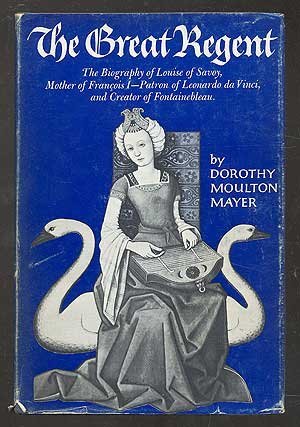
The Great Regent book cover

The difficult thing about researching and writing about French history can sometimes be finding sources when you don’t read the language. Completely by chance, I found this biography of Louise of Savoy in English and was thrilled. This book was written in 1966 and published by Funk and Wagnalls. The author herself has an interesting story.

Dorothy Moulton Mayer was an accomplished English singer. She married a German born philanthropist, Robert Mayer who was one of the founders of the London Philharmonic Orchestra. From the 1950’s on, Dorothy wrote several biographies including on Queen Marie Antoinette, painter Angelica Kaufman, violinist and composer Louis Spohr and this one on Louise of Savoy. I really have to admire her determination in writing these biographies.

Louise of Savoy was the mother of King François I of France. This in and of itself is not remarkable. What is significant is the fact that François trusted and relied on his mother so much that she basically ruled France from the time he took the throne in 1515 until her death in 1531. This served two purposes. François could continue to pursue his passions and pleasures such as hunting, conquering Italy and women. And secondly, Louise did an outstanding job when she was in charge of the government.

This can particularly be seen when François and his troops lost the Battle of Pavia in 1525 to the Holy Roman Emperor Charles V during the Italian Wars. François was taken prisoner and kept incarcerated in Spain until March of 1526. Louise was completely in charge in France and worked diligently to release the King. The Treaty of Madrid was brokered and François was released. However, in return he had to give up his two sons as hostages to Charles. Thereafter, Louise had to work even harder to get her grandsons released. She brokered the Treaty of Cambrai in 1529 along with her sister-in-law, Margaret of Austria who was acting on behalf of her nephew Charles V. This was called the Ladies Peace and Mayer gives a detailed description of the proceedings which is fascinating.

I really loved this book. Mayer’s writing is fluid and comprehensive. She gives lots of detail about the life of this remarkable lady including her upbringing under Anne de Beaujeu where she learned her craft and tidbits about her health. Her descriptions of her accomplishments are fair and balanced. Mayer talks about how historians have denigrated Louise’s actions and reputation. Mayer gives her own interpretations.

The book has a comprehensive bibliography of primary sources and there are some outstanding photos of contemporary art depicting Louise. And in the end there is a fascinating appendix. Mayer sent Louise’s handwritten letter to the Emperor Charles V after her beloved son King François was taken prisoner to a handwriting expert. She includes the expert’s interpretation of the writer’s personality. I think you will find the essence of Louise’s character it what he has written. Louise is a lady to admire and I highly recommend this book.

Book Review: “The Seymours of Wolf Hall: A Tudor Family Story” by David Loades

The Seymours of Wolf Hall book cover

It seems the Seymour family is more interesting than they appear on the surface. Most who know Tudor history are familiar with Jane Seymour, third wife of King Henry VIII and mother of King Edward VI. Others may have heard of Jane’s brothers, the dour Lord Protector Edward, Duke of Somerset and the swashbuckling Thomas, Baron Seymour of Sudeley and Lord Admiral. This book goes into even more depth about the family.

The introduction and initial chapter traces the Seymour ancestry back to France and how they migrated to England. I found the information on Jane’s father Sir John Seymour to be of great interest. He was a man of means and had ties to the court but didn’t spend much time there, choosing to live in Wiltshire and tend to business at home. Edward and Thomas were introduced to court and had valid careers in the navy, as gentlemen of the court and in Edward’s case as a successful soldier.

There are chapters in the book dedicated to Jane, Edward, Thomas and other siblings. Something I found most interesting was how Henry VIII really took a liking to Edward and rewarded him. He was very much part of the inner circle of the King. In addition to being the uncle of Edward VI, this is how he earned his important place on the council to rule England during Edward’s minority after Henry’s death. Loades also clarifies the reasons for Edward’s downfall. Thomas is by far the most attention-grabbing figure in the family. Mercurial and indiscreet, he seems to have set in motion all the mechanisms for his own downfall. The last part of the book traces the descendants of Edward Seymour and his wife Anne Stanhope down to the present day.

I’ve never read anything by Loades before and he certainly has the credentials of a competent historian. He puts his own spin on all aspects of this family which I found new and refreshing. Because of this, I recommend this book. My only quibble is the format of the book. It seems the author penned the book and sent the manuscript to the publisher and it was published straight from that. The paragraphs all run together and there are some grammatical and punctuation errors. Most egregiously, there is no index for the book. The publisher could have engaged the services of an editor to correct these errors but it doesn’t detract from the history as presented by the author.

Book Review: “The Sisters Who Would Be Queen: A Tudor Tragedy” by Leanda de Lisle

The Sisters Who Would Be Queen book cover

Several years ago I read a fascinating biography of Lady Jane Grey, known as the Nine Days Queen. It was written by Eric Ives and the subtitle of the book was “A Tudor Mystery”. So little is known about Jane who was a key personality in the Tudor era. I knew even less about Jane’s sisters Katherine and Mary. So when I found this book I was intrigued.

Since Ives has written a complete work on Jane, this book doesn’t really give much additional information about her. However, the information on Katherine and Mary here gives a complete picture of their lives. All these women were technically in line to inherit the throne of England based on the will of King Henry VIII and then the revisions made by King Edward VI. Edward really put these women in the spotlight, essentially putting their lives in danger, especially Jane.

Jane was used as pawn by John Dudley, Duke of Northumberland. Just before King Edward died, Northumberland married Jane to his own son Guildford. When Edward finally died, Northumberland had Jane and his son proclaimed Queen and King. This state of affairs only lasted about ten days, until Edward’s sister Princess Mary proclaimed herself Queen and forced Jane and Guildford to become prisoners in the Tower. Jane was beheaded a few months later.

Katherine’s story is for me the most fascinating. She managed to marry a Seymour in secret without the Queen’s permission. Even more interesting, she managed to have a son. After this, Queen Elizabeth I had Katherine held prisoner in the Tower along with her husband. They were allowed to see each other while incarcerated and Katherine managed to have another son! This led to the couple being separated and Katherine died an unfortunate death a few years later. De Lisle discloses in this book that there is a first-hand account of Katherine’s death and as it’s written here, it’s very emotional reading.

The last sister Mary managed to live the most conventional life of the three women but that’s putting it mildly. She was born deformed and was a very small person. But this probably saved her life because she wasn’t seen as a serious threat to the throne because of it. She married without the Queen’s permission like her sister and was also separated from her husband. He eventually died and Mary was able to carve out a living for herself as a comfortable widow.

All this makes for a fascinating story and de Lisle does a good job here recounting the lives of the three women. I have to admit her grammar and syntax drove me a little batty and sometimes she had me wondering if I was reading historical fiction or not. But it’s a pleasant book and I would recommend it if you are interested in the subject.